
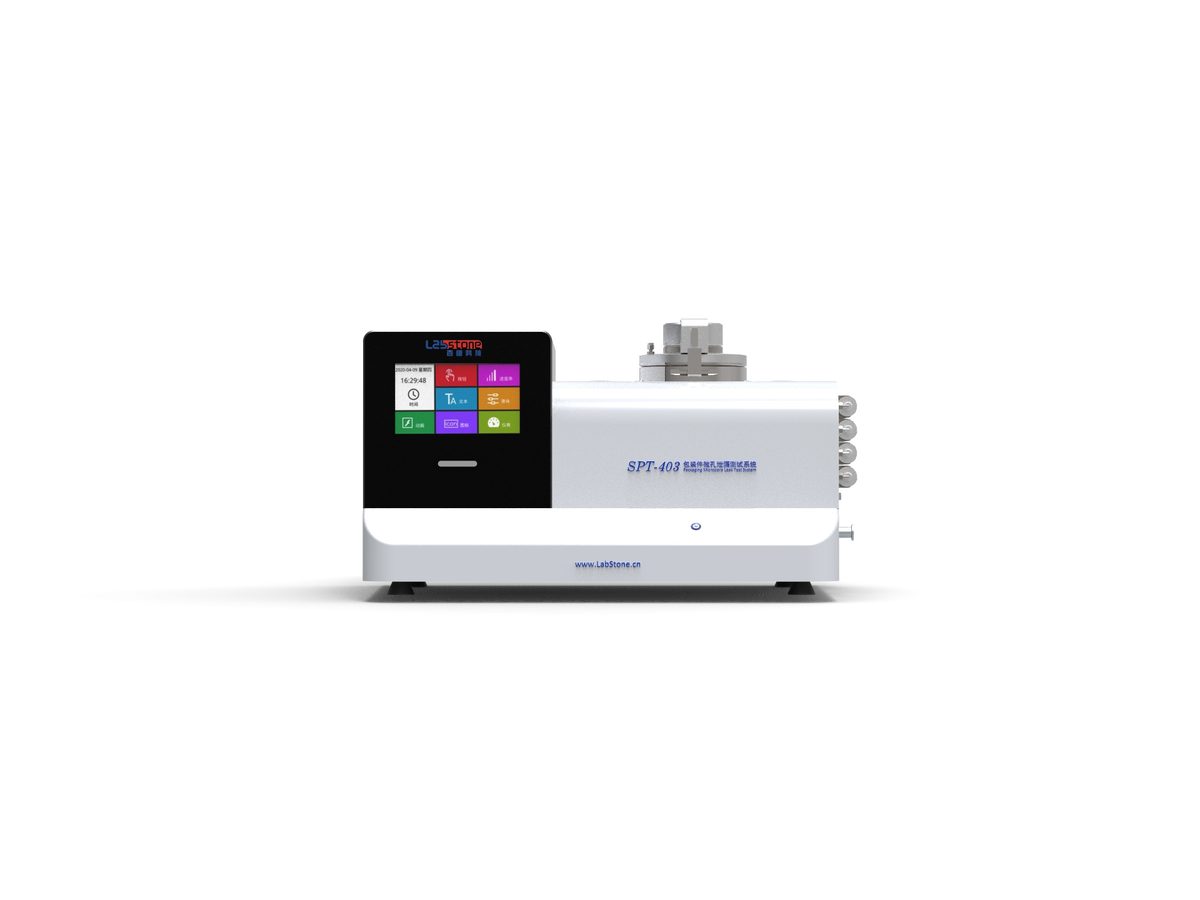
Packaging Integrity Tester – Vacuum Decay Method
Measures leak rate and leak aperture of flexible and rigid packs without destroying the sample: detectable leak diameter 0.5–50 µm, compliant with ASTM F2338 and USP <1207> — the standard method for sterile pharmaceutical package integrity studies.
Purpose | What it does for you
Non-destructively measures the leak rate and leak aperture of flexible and rigid packaging components, evaluating gross, medium, small and micro leaks. For sterile drugs, biologics and medical devices, package seal integrity directly determines the sterility assurance level. Because vacuum decay does not destroy the sample, you can inspect 100% of a batch or retest the same sample at several stability time points — something destructive dye-bath or microbial challenge methods cannot do.
Key Features
- Non-destructive: enables 100% inspection and repeated stability testing of the same sample
- Evaluates gross, medium, small and micro leaks; test fixtures customised to your package
- Three calibration modes: positive control, flow-rate calibration, negative control; positive controls 2/5/10 µm
- One-key start, fully automatic, with automatic pass/fail judgement against preset limits
- Real-time graphical recording of the whole process; data preserved on power loss
- Power-on self-check prevents continued testing in a faulty state
- Runs at room temperature — no climate-controlled room required
Operating Principle
Vacuum decay method: the package and fixture are placed in the test chamber and the lid sealed. Gross leak detection — the space around package, chamber and fixture is evacuated for a period, the valve is closed and the pressure change monitored, then compared with a standard sample. Small/micro leak detection — once no gross leak is found the instrument evacuates again, closes the valve and a sensor tracks pressure change over time; comparison with the standard yields leak rate and leak aperture.
Technical Specifications
| Detectable Leak Diameter | 0.5 µm–50 µm, >50 µm; error 0.5 µm; 5% m.v. (max) |
|---|---|
| Leakage Rate Range | 2.8×10⁻⁵ ~ 1 std·cm³/s; error 2.8×10⁻⁵ std·cm³/s |
| Vacuum Measurement Range | Vacuum sensor 0.1–1333.33 Pa, error 0.5 Pa |
| Absolute Pressure Sensor | Absolute pressure sensor 0–0.15 MPa, error 0.5 kPa |
| Vacuum Level | Test chamber vacuum <20 Pa during micro-leak detection |
| Test Efficiency | Large-leak detection (single cycle) <1 min; medium/small/micro-leak detection >1 min |
| Calibration | Calibration flow 0–2 cc/min (automatic), repeatability <0.5% FS; linearity R²>0.995 |
| Monitoring | Computer + colour touchscreen |
| Dimensions | 330(L) × 450(B) × 380(H) mm |
| Net Weight | ~18 kg |
| Power Supply | AC 220/110 V ±10%,50/60 Hz |
| Power | ≤800 W |
Note: Due to continuous product iteration and varying application conditions, the technical parameters on this page are typical reference values and are not to be used as acceptance criteria. For tender and customized projects, the product model, configuration and specifications are subject to the mutually confirmed technical agreement and the actual delivered product. For parameter matching tailored to your specific project, please contact us.
Standard Configuration
SPT-401 test main unit, Dell computer (tower, monitor, mouse, keyboard), RS232 cable, professional SPT software (including GMP module), VRD-4 vacuum pump, sample fixture (customised to your package), negative control, positive controls (2/5/10 µm), and 3Q validation service. User supplies a lab bench and power distribution.
Application Scenarios
- Seal integrity studies of sterile injectables, lyophilised powders and infusion bags
- Leak detection of prefilled syringes, cartridges and pharmaceutical glass vials
- Validation of sterile barrier systems (SBS) for medical devices
- Micro-leak sampling of flexible food packaging (vacuum, nitrogen-flushed, retort pouches)
- Leak testing of blister packs, foil-laminate pouches and pharmaceutical laminated films
Compliance Standards
Industries Served
- Pharmaceutical & Biopharmaceutical
- Medical Devices
- Food & Condiments
- Packaging & Printing
- Third-Party & Government Testing Institutes
- Public Health CDC & Customs Technical Centers
- Cosmetics & Personal Care
Frequently Asked Questions
Is the fixture customised to our packaging, and how long does that take?
Yes. Each instrument includes one sample fixture customised to your package, plus a negative control made to the package specification. Customisation typically takes 2–4 weeks after order confirmation; we need package drawings or physical samples.
How small a leak can the vacuum decay method detect?
It covers leak apertures from 0.5 µm to 50 µm (aperture error 0.5 µm), with anything above 50 µm classified as a gross leak; the corresponding leak rate range is 2.8×10⁻⁵ to 1 std·cm³/s. For micro-leak testing the chamber is evacuated below 20 Pa. On speed: a gross leak resolves in under one minute per cycle, while medium, small and micro leaks take longer than a minute. This range covers the container closure integrity requirements commonly applied to sterile pharmaceuticals and medical devices.
What does non-destructive testing actually change for a pharmaceutical plant?
Traditional methods such as dye penetration must destroy the package to reach a verdict, so the sample is consumed by the test. Vacuum decay places the package in a sealed chamber, draws a vacuum and monitors the pressure rise — nothing is punctured or immersed. Three practical consequences: the same vial or infusion bag can be tested and then returned to the stability study, with no extra sample consumed; high-value biologics can be inspected at a much higher sampling ratio, up to 100%; and because no liquid is introduced, the sample is unchanged after testing and carries no interference into subsequent analyses.
Does LabStone support OEM/ODM and customised instruments?
Yes. Standard models ship as-is, while chamber count, specimen size, fixtures, temperature range and software modules (including the GMP Computerized System module) can be tailored to your SOP and URS. IQ/OQ/PQ validation documentation packages are available.
What is the typical lead time, and how is shipping handled?
Standard models usually ship in 4–8 weeks; customised builds depend on the agreed scope. Instruments are packed in export wooden cases and can move by sea, air or rail. We supply proforma invoice, packing list and certificate of origin (CO / Form E), and work under EXW, FOB, CIF or DAP terms.
How are installation, training and calibration handled after delivery?
We provide remote installation guidance, bilingual (Chinese/English) manuals and video training; on-site commissioning by our engineers is available. Users can self-calibrate with standard weights, reference films or calibrated leak standards, and third-party calibration certificates can be supplied.
What is the warranty, and how are spare parts supplied?
The instrument carries a 12-month warranty from acceptance plus lifetime maintenance support. Consumables (molecular sieve, desiccant, sealing grease, printer paper) are kept in long-term stock, and key components are international brands available worldwide. We respond to technical enquiries within 24 hours.
Do the instruments comply with ASTM, ISO and pharmacopoeia standards?
Yes. Every instrument lists its applicable standards on the specification page (ASTM, ISO, GB, YBB, Chinese Pharmacopoeia, USP, EP, JIS, DIN, TAPPI and more). The software outputs raw records and reports suitable for audit trails, with an optional GMP / FDA 21 CFR Part 11 compliance module.
Which languages does the software support, and can it integrate with a LIMS?
The software ships with Chinese and English interfaces; other languages can be added on request. Data export is available over RS232, USB, Ethernet or Wi-Fi, and reports can be exported to Excel, PDF or structured files for LIMS integration.