
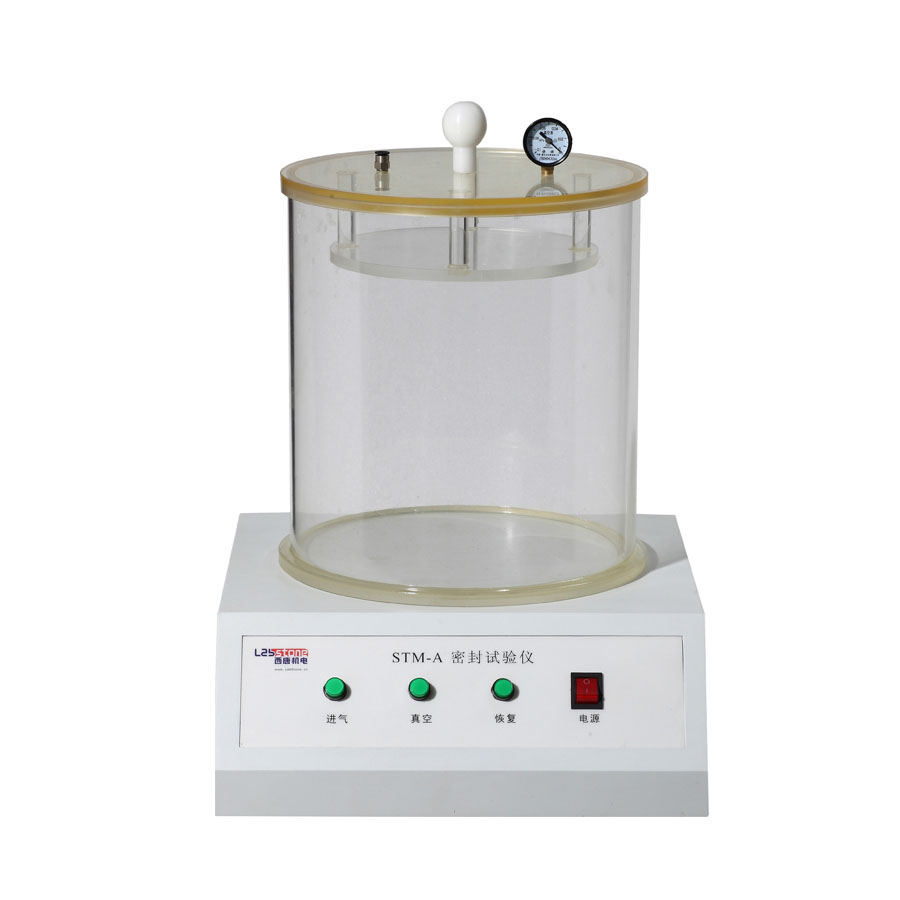
Leak Tester (Seal Strength & Leakage)
Seal strength and leakage testing of flexible packaging by vacuum or positive pressure — the most fundamental QC tool for food, pharmaceutical and household flexible packaging, intuitive and fast.
Purpose | What it does for you
Checks the seal and leaks of flexible pouches, bottles and tubes by applying vacuum or positive pressure and observing leakage, delamination or bursting; it also evaluates heat-seal strength. Suited to incoming inspection, in-process sampling and release testing in food, pharmaceutical, household and medical packaging — an essential basic tool for any packaging workshop.
Key Features
- Vacuum and positive-pressure methods available, covering both seal integrity and pressure resistance
- Bubble observation is intuitive — leak location is immediately visible for fast line-side judgement
- Digitally set pressure and dwell time for repeatable results
- Compact and easy to operate, with no complex training required
- The STM-C intelligent model adds programme control, data logging and report output
Operating Principle
Vacuum method: the package is immersed in water inside a vacuum vessel; the pressure difference created by evacuation makes any leak visible as a continuous stream of bubbles, revealing leak location and severity. Positive-pressure method: the package is pressurised with compressed air to a set value and held; pressure decay or bursting is observed to assess seal strength and pressure resistance.
Technical Specifications
| Vacuum Measurement Range | 0 ~ -90 kPa (vacuum method) |
|---|---|
| Range | 0 ~ 0.6 MPa (positive pressure, STM-P) |
| Accuracy | ±1% FS |
| Vacuum Vessel | vacuum vessel selected by package size |
| Gas Supply Pressure | 0.7–0.8 MPa (user-supplied) |
| Power Supply | AC 220/110 V ±10%,50/60 Hz |
Note: Due to continuous product iteration and varying application conditions, the technical parameters on this page are typical reference values and are not to be used as acceptance criteria. For tender and customized projects, the product model, configuration and specifications are subject to the mutually confirmed technical agreement and the actual delivered product. For parameter matching tailored to your specific project, please contact us.
Standard Configuration
Main unit, vacuum vessel (selected by size), tubing and fittings, manual. User supplies compressed air (positive-pressure method) and power. Final scope per the configuration list.
Application Scenarios
- Leak detection for flexible food pouches (snacks, frozen foods, sauce sachets)
- Seal inspection of pharmaceutical laminated pouches, granules and powder packs
- Leak testing of cosmetic tubes, shampoo sachets and wet-wipe packs
- Seal quality verification after optimising heat-sealing parameters
Compliance Standards
Industries Served
- Food & Condiments
- Pharmaceutical & Biopharmaceutical
- Packaging & Printing
- Cosmetics & Personal Care
- Medical Devices
- Daily Knives & Hardware
- Third-Party & Government Testing Institutes
Frequently Asked Questions
Should I choose the vacuum or the positive-pressure method?
It depends on whether your package sees external or internal pressure in service, and on what the standard prescribes. Most flexible packaging standards (GB/T 15171, ASTM D3078) specify the vacuum method, which shows leaks visually; choose positive pressure to assess pressure resistance, creep or burst. If unsure, send samples for a method comparison.
Does LabStone support OEM/ODM and customised instruments?
Yes. Standard models ship as-is, while chamber count, specimen size, fixtures, temperature range and software modules (including the GMP Computerized System module) can be tailored to your SOP and URS. IQ/OQ/PQ validation documentation packages are available.
What is the typical lead time, and how is shipping handled?
Standard models usually ship in 4–8 weeks; customised builds depend on the agreed scope. Instruments are packed in export wooden cases and can move by sea, air or rail. We supply proforma invoice, packing list and certificate of origin (CO / Form E), and work under EXW, FOB, CIF or DAP terms.
How are installation, training and calibration handled after delivery?
We provide remote installation guidance, bilingual (Chinese/English) manuals and video training; on-site commissioning by our engineers is available. Users can self-calibrate with standard weights, reference films or calibrated leak standards, and third-party calibration certificates can be supplied.
What is the warranty, and how are spare parts supplied?
The instrument carries a 12-month warranty from acceptance plus lifetime maintenance support. Consumables (molecular sieve, desiccant, sealing grease, printer paper) are kept in long-term stock, and key components are international brands available worldwide. We respond to technical enquiries within 24 hours.
Do the instruments comply with ASTM, ISO and pharmacopoeia standards?
Yes. Every instrument lists its applicable standards on the specification page (ASTM, ISO, GB, YBB, Chinese Pharmacopoeia, USP, EP, JIS, DIN, TAPPI and more). The software outputs raw records and reports suitable for audit trails, with an optional GMP / FDA 21 CFR Part 11 compliance module.
Which languages does the software support, and can it integrate with a LIMS?
The software ships with Chinese and English interfaces; other languages can be added on request. Data export is available over RS232, USB, Ethernet or Wi-Fi, and reports can be exported to Excel, PDF or structured files for LIMS integration.