Ignition residue (residue on ignition) is the pharmacopoeial limit test for non-volatile inorganic impurities in organic drugs. Under Chinese Pharmacopoeia Method 0841, 1.0–2.0 g of sample is gently carbonised, moistened with sulphuric acid and ignited at 700–800°C to complete ashing, then ignited to constant weight. The residue remains as sulphates and the limit is set by each individual monograph.
1. Typical range
The ignition-residue limit is typically within 0.1%–0.2%, with common specified values of 0.1%, 0.2%, 0.5% and 1.0% defined by the monograph. Sample size follows the limit: about 1 g for a 0.1% limit, about 2 g for 0.05%, and under 1 g when the limit exceeds 1%, keeping the residue mass in the convenient 1–2 mg range.
2. Standard and apparatus
The method follows General Chapter 0841 of the Chinese Pharmacopoeia (2020 edition), corresponding to USP <281> Residue on Ignition and the BP Sulphated Ash test. It requires a muffle furnace (700–800°C), an analytical balance (0.1 mg), a crucible (platinum if alkali metal or fluoride is present) and a desiccator. If the residue is to be used for a heavy-metals test, ignition must be held at 500–600°C.
3. Procedure
Take a crucible ignited to constant weight, accurately weigh 1.0–2.0 g of sample, gently ignite to complete carbonisation and cool; add 0.5–1 mL of sulphuric acid to moisten, heat at low temperature until sulphur trioxide fumes cease; ignite at 700–800°C to complete ashing, cool in a desiccator, weigh accurately, then ignite again at 700–800°C to constant weight (two consecutive masses within the specified difference).
4. Calculation
Ignition residue (%) = (residue mass − empty crucible mass) / sample mass × 100%. A result equal to or below the limit is compliant; above the limit it is non-compliant. Constant weight is judged when the residue mass difference after two consecutive ignitions is below the specified value (e.g. 0.5 mg or the monograph requirement).
5. Key precautions
Carbonise gently to avoid burning or spattering of the sample; use a platinum crucible for alkali-metal or fluoride-containing substances to avoid attacking porcelain; open the desiccator carefully after removal from the furnace to avoid blowing away light residue; for heavy-metal checks keep 500–600°C so metals do not volatilise.
6. LabStone solution
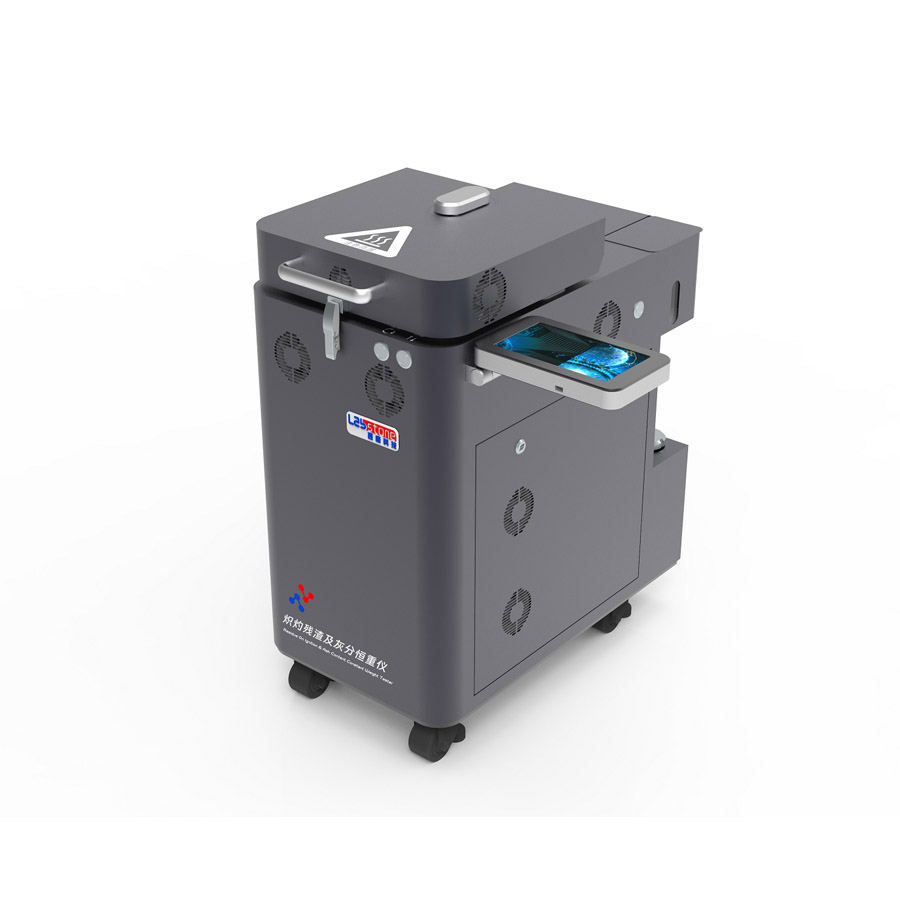
The LabStone IRT-A Ignition Residue & Ash Tester automatically performs carbonisation, acid addition, ashing and constant-weight weighing across 500–1000°C, reaching 0.3 mg constant weight within two cycles with no manual handling of red-hot crucibles. It fits ChP 0841 as well as ash/ignition methods such as GB/T 642 and GB/T 212.