
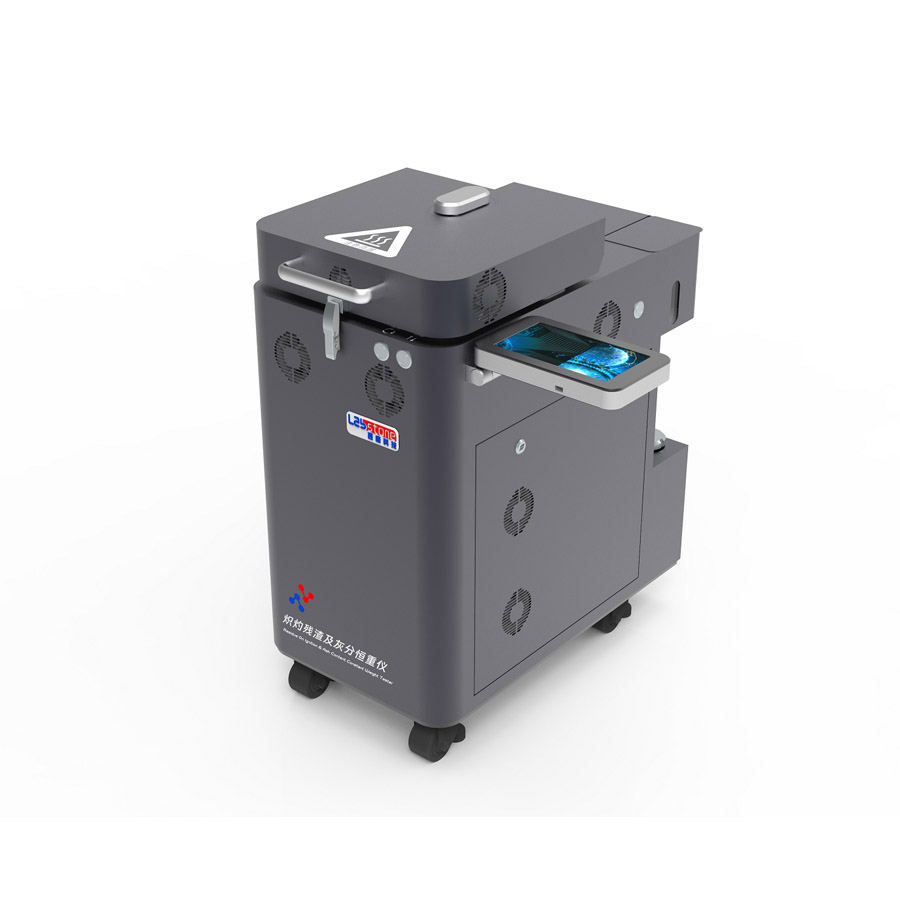
Ignition Residue & Ash Determination Instrument
Muffle furnace, drying oven, desiccator and balance in one cabinet — automated ignition to constant weight at 500–1000 °C, constant weight within 0.3 mg in two cycles, with no handling of red-hot crucibles.
Purpose | What it does for you
For high-temperature gravimetric work — ignition residue, loss on ignition (LOI), total ash, acid-insoluble ash, loss on drying, TDS and suspended solids — it fully replaces the muffle furnace, drying oven, desiccator and manual repeat weighing. Traditionally an operator must repeatedly remove crucibles at 500–1000 °C with heat-proof gloves, cool, weigh and return them to the furnace: three or four rounds consuming a full day. This instrument performs ignition, drying, cooling and constant-temperature weighing inside a closed cabinet, unattended — removing both the hot-handling hazard and the moisture/dust errors of transfer.
Key Features
- Compliant with pharmacopoeia and national standard procedures, fully automated drying and ignition
- 0.3 mg constant weight accuracy, 12 / 16 / 19 / 32 workstations
- Drying, ignition, cooling and weighing integrated in one cabinet — compact footprint
- Stepped temperature ramp with fully automatic control of rate and dwell time
- Patented balance isolation: thermal, moisture, corrosion and flame protection
- Anti-combustion and anti-explosion design with automatic over-temperature shutdown
- Optional sulfuric acid dosing unit for sulphated ash / ignition residue preparation
Operating Principle
The cycle is ignition → drying → constant-temperature weighing. Crucibles are carried by a lift-and-rotate rack into the furnace (ambient to 1000 °C, programmable ramp 0–50 °C/min) and ignited per the standard programme; they then cool in a water-cooled chamber to the setpoint before being weighed by the built-in METTLER TOLEDO balance (0.1 mg). The instrument repeats the ignite–cool–weigh loop until two consecutive readings differ by less than 0.3 mg. The balance is isolated by patented heat, moisture, corrosion and flame protection.
Technical Specifications
| Constant Weight Error | 0.3 mg |
|---|---|
| Balance Range | 220 g (METTLER TOLEDO) |
| Balance Resolution | 0.1 mg |
| Temperature Range | RT~1000 ℃ |
| Temperature Error | (RT–150)℃ ±0.5 ℃; (150–1000)℃ ±2 ℃ |
| Heating Rate | 0–50 ℃/min |
| Heating Steps | 20 |
| Weighing Temperature | RT~100 ℃ |
| Crucible Capacity | 10 mL (custom sizes available) |
| Atmosphere | compressed air, inert gas |
| Gas Supply Pressure | >0.3 MPa |
| Interface Size | Φ8 mm PU tubing |
| Power Supply | AC 220/110 V ±10%,50/60 Hz |
| Power | ≤6000 W |
Note: Due to continuous product iteration and varying application conditions, the technical parameters on this page are typical reference values and are not to be used as acceptance criteria. For tender and customized projects, the product model, configuration and specifications are subject to the mutually confirmed technical agreement and the actual delivered product. For parameter matching tailored to your specific project, please contact us.
Models & Configuration
| Model | IRT-121-D | IRT-161-D | IRT-191-D | IRT-311-D |
|---|---|---|---|---|
| Specimen Count | 12 | 16 | 19 | 32 |
| Residue Range | 0.1 mg–50 g | 0.1 mg–50 g | 0–50 g | 0–50 g |
| Cooling Method | Water-cooled | Water-cooled | Internal air-cooled + external water-cooled | Internal air-cooled + external water-cooled |
| Chamber Volume | — | — | 6.5 L | 6.5 L |
| Dimensions | 1105×750×985 mm | 1105×750×985 mm | 1105×950×985 mm | 1105×950×985 mm |
| Net Weight | 75 kg | 85 kg | 165 kg | 180 kg |
| Standard Crucibles | 12 | 16 | 23 | 36 |
| Balance Count | 1 | 1 | 1 | 1 |
Standard Configuration
Main unit, quartz crucibles (one per cavity), professional software, gas/water tubing. Optional: corundum and ceramic crucibles, sulfuric acid dosing unit. User supplies a computer, compressed air, inert gas cylinder, acid/alkali and purified water.
Application Scenarios
- Ignition residue test for pharmaceuticals (Chinese Pharmacopoeia Part IV)
- Total ash and acid-insoluble ash in food (GB 5009.4)
- Ash and loss on ignition of solid waste and incineration residues (HJ 1024, HJ 761, GB 18485)
- Ash content of coal, coke and carbon materials (GB/T 212, GB/T 2295)
- Ash of plastics and rubber (GB/T 9345, GB/T 4498.1, GB/T 7531)
- Constant-weight determination of suspended solids (SS) and total dissolved solids (TDS) in water
- Crude ash in feed, cereals and agricultural products (GB/T 6438)
Compliance Standards
Industries Served
- Pharmaceutical & Biopharmaceutical
- Food & Condiments
- Traditional Chinese Medicine & Herbal
- Environmental Monitoring & Solid Waste
- Public Health CDC & Customs Technical Centers
- Third-Party & Government Testing Institutes
- Petrochemical & Energy
- Material R&D, Universities & Institutes
- Plastics & Rubber
- Building Materials & Construction
Frequently Asked Questions
How does result consistency compare with a conventional muffle furnace?
The constant-weight decision is executed automatically against a 0.3 mg threshold, with cooling temperature, dwell time and weighing humidity all under programme control — removing human judgement. Samples stay inside the sealed chamber, insulated from lab temperature, humidity and dust, so within-batch and between-batch consistency beats manual operation.
What are the limits on maximum temperature and crucible material?
The furnace covers ambient to 1000 °C and ships with 10 mL quartz crucibles; corundum and ceramic crucibles are optional and other capacities can be made to order. If your method needs a higher temperature or a special atmosphere, note it in your URS and we will evaluate furnace lining and sealing options.
Can acid-requiring steps such as acid-insoluble ash be automated?
The ignite–cool–weigh loop is fully automatic; the acid addition step can be performed inside the instrument using the optional sulfuric acid dosing unit, avoiding operator contact with strong acid and reducing transfers. The exact sequence can be configured into the software method to match your SOP.
Why is the constant-weight criterion set at 0.3 mg?
Pharmacopoeias and GB methods usually define constant weight as a difference of no more than 0.3 mg between two consecutive weighings (a few standards use 0.5 mg or 0.2 mg). The instrument judges at ≤0.3 mg by default, which covers most pharmacopoeia and food-contact methods; if your standard specifies another criterion, confirm applicability with an engineer before ordering.
Are evaporation residue, non-volatile matter and overall migration the same thing?
No. Overall migration is the total non-volatile substance transferred from a food-contact material under a specified simulant and contact condition; evaporation residue is the mass left after the soak or extract solution is taken to dryness; non-volatile matter refers specifically to the fraction that does not volatilise at that temperature. Their sample preparation and simulants differ, but all three end with evaporation, drying and constant-weight weighing, so one constant-weight tester serves them all.
Can loss on drying be reported directly as water content?
They are not equivalent. Loss on drying is everything the sample loses at the specified temperature — water, residual solvent and other volatile components; water content means H₂O specifically and is usually determined by Karl Fischer titration or a dedicated moisture analyser. The two figures approach each other only when water is the sole volatile present. A compliance report should state the method and conditions for each.
How do ignition residue, ash, acid-insoluble ash and loss on ignition differ?
The four differ in temperature, duration and preparation, but all end in the same high-temperature ignition, cooling and constant-weight weighing step, so one high-temperature instrument covers them. Ignition residue is the inorganic residue left after high-temperature ignition; ash is what remains after food, pharmaceutical or herbal material is ignited at a specified temperature; acid-insoluble ash treats the ash further with acid and keeps only the insoluble part, to reveal sand and other extraneous matter; loss on ignition (LOI) is the mass percentage lost by solid waste, building materials or minerals at high temperature.
Does LabStone support OEM/ODM and customised instruments?
Yes. Standard models ship as-is, while chamber count, specimen size, fixtures, temperature range and software modules (including the GMP Computerized System module) can be tailored to your SOP and URS. IQ/OQ/PQ validation documentation packages are available.
What is the typical lead time, and how is shipping handled?
Standard models usually ship in 4–8 weeks; customised builds depend on the agreed scope. Instruments are packed in export wooden cases and can move by sea, air or rail. We supply proforma invoice, packing list and certificate of origin (CO / Form E), and work under EXW, FOB, CIF or DAP terms.
How are installation, training and calibration handled after delivery?
We provide remote installation guidance, bilingual (Chinese/English) manuals and video training; on-site commissioning by our engineers is available. Users can self-calibrate with standard weights, reference films or calibrated leak standards, and third-party calibration certificates can be supplied.
What is the warranty, and how are spare parts supplied?
The instrument carries a 12-month warranty from acceptance plus lifetime maintenance support. Consumables (molecular sieve, desiccant, sealing grease, printer paper) are kept in long-term stock, and key components are international brands available worldwide. We respond to technical enquiries within 24 hours.
Do the instruments comply with ASTM, ISO and pharmacopoeia standards?
Yes. Every instrument lists its applicable standards on the specification page (ASTM, ISO, GB, YBB, Chinese Pharmacopoeia, USP, EP, JIS, DIN, TAPPI and more). The software outputs raw records and reports suitable for audit trails, with an optional GMP / FDA 21 CFR Part 11 compliance module.
Which languages does the software support, and can it integrate with a LIMS?
The software ships with Chinese and English interfaces; other languages can be added on request. Data export is available over RS232, USB, Ethernet or Wi-Fi, and reports can be exported to Excel, PDF or structured files for LIMS integration.