The 105°C oven method, or atmospheric-pressure drying method, is the reference first method 'direct drying' in GB 5009.3 'National Food Safety Standard — Determination of Moisture in Foods'. It drives off moisture and other volatile matter from a sample at 101.3 kPa and 101–105°C, then calculates moisture from the mass lost after drying. It applies to foods with moisture not lower than 0.5 g/100 g, such as cereals, aquatic products, dairy and meat.
1. Scope and standards
This is Method I of GB 5009.3-2016 and aligns with GB/T 5497 and the reference method ISO 712 for grain moisture. It suits cereals and their products, aquatic products, soy products, dairy and meat where little other volatile matter is present. It is not applicable to samples with moisture below 0.5 g/100 g, nor to confectionery and similar multi-ingredient products.
2. Apparatus and sample
Required equipment includes a forced-air drying oven, an analytical balance readable to 0.1 mg, a covered shallow weighing dish (aluminium or glass, 60–70 mm inner diameter, 30–35 mm high) and a desiccator. Solid samples are ground to particles under 2 mm and 2–10 g is weighed to 0.0001 g, spread no thicker than 5 mm (10 mm for loose samples).
3. Procedure
Step 1, tare the dish: heat it at 101–105°C for 1.0 h, cool in a desiccator for 0.5 h, weigh, and repeat drying until two consecutive weighings differ by no more than 2 mg. Step 2, weigh the sample into the dish. Step 3, dry with the lid slightly ajar at 101–105°C for 2–4 h, cool 0.5 h and weigh. Step 4, dry about 1 h more, cool, weigh, and repeat until the mass difference is within 2 mg.
4. Calculation
Moisture content X (g/100 g) = (m1 − m2) / (m1 − m0) × 100%, where m1 is the dish-plus-sample mass, m2 the mass after drying, and m0 the tared empty dish mass. Report three significant figures when X ≥ 1 g/100 g and two when below; under repeatability the absolute difference of two determinations must not exceed 10% of their arithmetic mean.
5. Critical controls
For constant weight, take the lower of the two final masses as the result; keep the desiccant effective; for semi-solid or liquid samples use acid- and alkali-washed, 105°C-dried sea sand. Hold temperature strictly at 101–105°C to avoid scorching the sample, which would raise the result.
6. LabStone solution
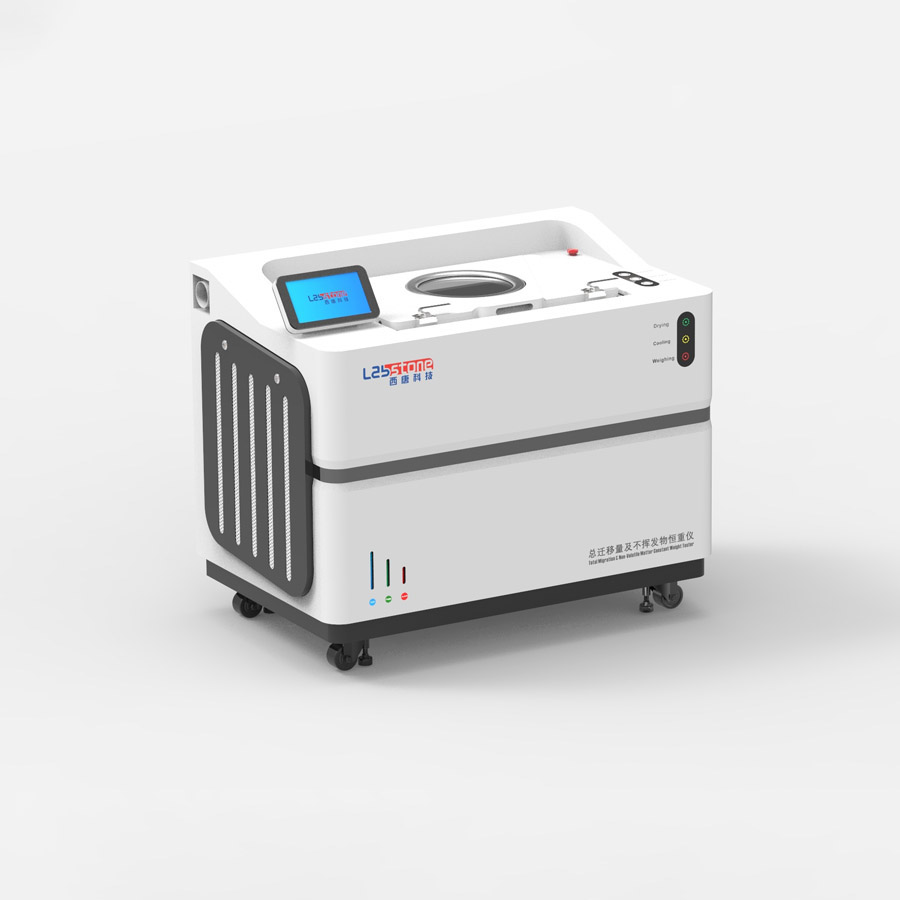
The LabStone ERT-C Water-Bath Evaporation Constant-Weight Tester automates the full cycle of 105°C constant-temperature water-bath evaporation/drying, cooling and constant-weight weighing. It reaches 0.3 mg constant weight within two cycles, replacing the manually attended oven and balance, and improving both throughput and consistency of GB 5009.3 moisture and loss-on-drying work.