EU 10/2011 is the European Union regulation on plastic materials and articles intended to come into contact with food. It requires every plastic food contact material to pass migration compliance testing. The core limit is the overall migration limit (OML) of 10 mg/dm² of food contact surface (60 mg/kg of simulant for infant articles and small-capacity items). Testing contacts the material with food simulants A–E under defined time-temperature conditions, then evaporates the simulant and weighs the non-volatile residue gravimetrically (EN 1186 series).
1. The two kinds of limits
The overall migration limit (OML) measures the total inertness of the material — all non-volatile substances released into food — at a uniform 10 mg/dm² for any plastic contact surface. Specific migration limits (SML) apply to individual monomers and additives on the Union list (Annex I), derived from toxicological data and expressed in mg/kg. For articles intended for infants and young children, the OML applies as 60 mg/kg of simulant.
2. Food simulants A–E
| Simulant | Composition | Food represented |
|---|---|---|
| A | 10% ethanol | Hydrophilic aqueous foods |
| B | 3% acetic acid | Acidic foods (pH<4.5) |
| C | 20% ethanol | Alcoholic foods up to 20% alcohol |
| D1 | 50% ethanol | High-alcohol drinks, oil-in-water emulsions |
| D2 | Vegetable oil | Fatty foods |
| E | Tenax (modified polyphenylene oxide) | Dry foods (for specific migration) |
3. Time-temperature conditions (OM series)
Annex V maps real use to standard conditions. The most common is 10 days at 40°C for long-term room-temperature storage, including heating up to 70°C for 2 hours or 100°C for 15 minutes. Hot-fill use maps to 2 h at 70°C; applications up to 100°C map to 1–4 h or reflux, and up to 121°C to 2 h, with 2 h at 175°C covering the harshest fatty-food scenarios. Repeated-use articles must be tested three times on the same sample.
4. Test workflow: EN 1186 gravimetry
Overall migration is determined according to the EN 1186 series: after immersion or filling contact, the simulant is evaporated to dryness and the evaporation residue (non-volatile matter) is weighed and converted to migration per contact area. This is a classic constant-weight experiment — manual oven workflows are slow and environment-sensitive, while automatic constant-weight instruments automate evaporation, weighing and the constant-weight criterion (difference below 0.3 mg).
5. Compliance documentation
Every batch of plastic FCM placed on the EU market needs a Declaration of Compliance (DoC) stating the food types, conditions of use and SML-relevant substances; the supporting dossier must include migration test reports and a NIAS (non-intentionally added substances) risk assessment. Test conditions that fail to cover the harshest realistic use are the most common audit finding.
6. LabStone solution
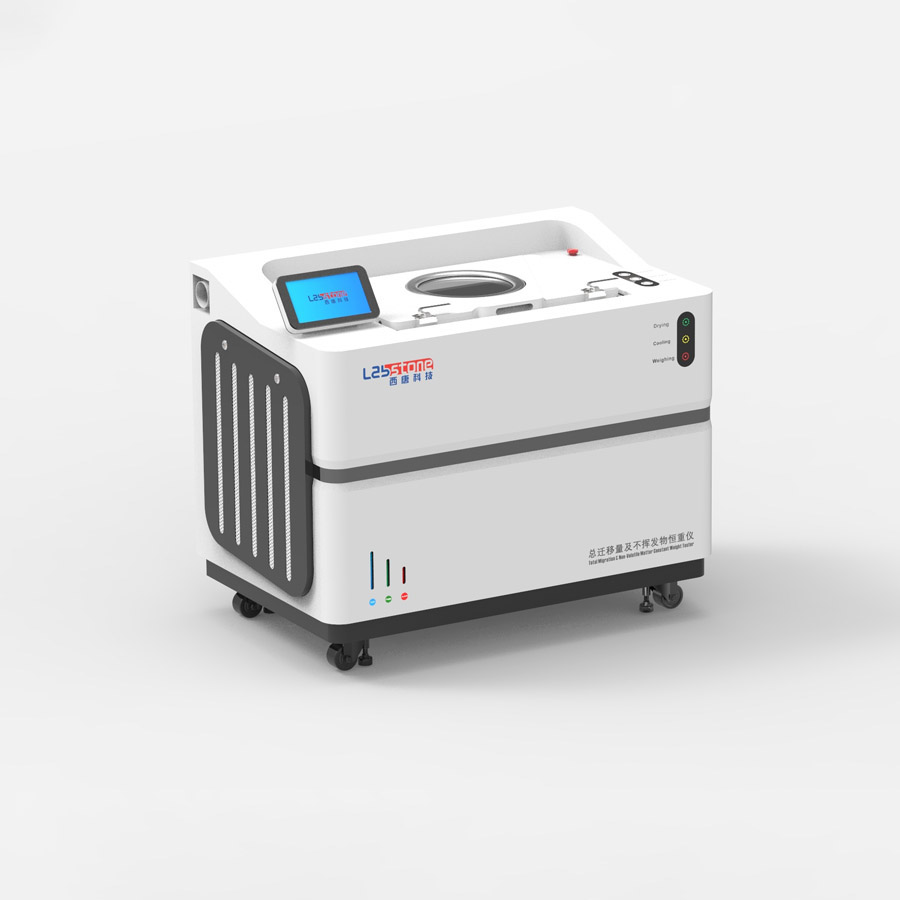
The LabStone ERT-C series overall migration and non-volatile residue constant-weight testers are built for gravimetric evaporation-residue and total-migration testing under EU 10/2011, the GB 31604 series and related standards: 105°C water-bath evaporation, two-round constant-weight difference below 0.3 mg, and automated batch sample handling that replaces manual constant-weight routines.