Non-volatile residue is the core extractables screening metric for pharmaceutical packaging films. Under the pharmacopoeial protocols applied to general laminated films and bags, three extracts are prepared in water, 65% ethanol and n-hexane, and 100 mL of each extract, together with its blank, is evaporated to dryness and dried at 105 °C; the residue difference against the blank must not exceed 30.0 mg in any of the three media. Infusion-grade multi-layer co-extruded film and bag materials face a far tighter limit of 2.5 mg after extraction with water at 121 °C for 30 minutes, reflecting direct contact with parenteral solutions. Every determination rests on the same gravimetric foundation: water-bath evaporation, controlled drying and precision weighing, which is why constant-weight discipline decides whether the data survives an audit. Published limits are material-level pass criteria: they cap what a film may release into contacting liquids, not what a drug formulation may contain.
1. What the two protocols each cover
Pharmacopoeial packaging standards for plastic film materials are tiered by clinical use. General laminated films and bags, serving oral and topical preparations, are screened by immersion for two hours in water and 65% ethanol at 70 °C ± 2 °C and in n-hexane at 58 °C ± 2 °C. Materials for large-volume infusion — multi-layer co-extruded films and bags of 50 mL and above — are extracted with water under autoclave conditions of 121 °C for 30 minutes, simulating steam sterilisation and long contact with the drug solution. Because infusion packaging touches the formulation directly and must survive thermal sterilisation, its limits are tighter, and the two material classes never borrow each other’s conditions or pass criteria in testing. Testing an infusion material under the general protocol would understate its real exposure by a wide margin.
2. Preparing the test extracts: 600 cm² and three solvents
Sample preparation is fixed and must be followed exactly. For laminated films, a specimen with an inner surface area of 600 cm² is cut into pieces roughly 3 cm × 0.3 cm, divided into three equal portions, and immersed in 200 mL each of water at 70 °C ± 2 °C, 65% ethanol at 70 °C ± 2 °C, and n-hexane at 58 °C ± 2 °C. After two hours the extracts are cooled to room temperature and topped back to their original volume with the same batch of solvent; the blank is prepared identically from the same solvent batches. The three solvents deliberately probe three migration families: polar substances, moderately polar extractables, and non-polar oligomers and additives. Deviating from the cut size, the solvent volume or the temperature changes the surface-to-volume ratio and therefore the mass of extractable material per millilitre, which invalidates any comparison with the published limits.
| Aspect | General laminated films and bags | Infusion-grade co-extruded film and bag |
|---|---|---|
| Material class | Pharmaceutical laminated film for oral and topical use | Multi-layer co-extruded film and bag, 50 mL and above |
| Extraction solvents | Water, 65% ethanol, n-hexane | Water |
| Extraction conditions | 2 h immersion at 70 °C ± 2 °C (n-hexane 58 °C ± 2 °C) | 121 °C for 30 min in an autoclave |
| Non-volatile residue limit | ≤30.0 mg vs blank for each extract (100 mL) | ≤2.5 mg (50 mL extract) |
| Companion metrics | Readily oxidisable substances, pH, UV absorbance, heavy metals | Ignited residue, element limits, bacterial endotoxins |
3. The gravimetric determination: constant weight underpins everything
The determination itself is deliberately simple. Exactly 100 mL of each test extract and of the corresponding blank is transferred into an evaporating dish that has itself been brought to constant weight. The liquid is evaporated to dryness on a water bath, dried at 105 °C for two hours, cooled in a desiccator and weighed precisely. The difference between the residue of the test solution and that of the blank is the non-volatile residue, and each of the three media must individually stay within the 30.0 mg allowance. Because the dish weight enters the result twice, any drift between the dish’s initial and final weighings is a systematic error that eats directly into the margin. The blank runs through the identical sequence, so solvent impurities appear in both weighings and cancel out, provided both dishes genuinely share the same thermal history.
Constant weight is the quiet pillar of the whole method. The evaporating dish must be dried and re-weighed repeatedly until two successive weighings agree within 0.3 mg, a criterion built on a balance with 0.1 mg readability. Actual residues are often only a few milligrams, so splashing during evaporation, dust ingress, or moisture re-absorbed during cooling can each consume a meaningful share of the allowance. In manual workflows the hardest part is keeping blanks and samples on an identical drying-and-cooling schedule; asynchronous handling is the first source of scatter in the data, and the reason accredited laboratories keep closing the loop instrumentally. That is why laboratories time the drying and cooling windows as rigorously as the weighing itself, and why differential weighing against a blank-carrying reference dish has become standard practice; consistency, not speed, is what makes the number citable.
4. Why infusion materials are held to a tighter standard
Infusion-grade films and bags are extracted with water at 121 °C for 30 minutes under autoclave pressure, reproducing clinical sterilisation and prolonged drug contact in the laboratory. The non-volatile residue limit of 2.5 mg is an order of magnitude stricter than the 30.0 mg applied to general laminated films. The same protocol also caps the ignited residue at 0.05% and sets element-specific limits for copper, cadmium, chromium, lead, tin and barium determined by atomic absorption spectrophotometry, alongside bacterial endotoxin requirements. Read together, these numbers form a coherent safety dossier for a material whose failure mode is direct delivery of migrants into a parenteral formulation. A material that passes extraction at room temperature can fail outright once it has been steam-sterilised, which is why the harsher condition is not bureaucratic caution but a faithful model of real clinical use.
5. The companion extractables metrics
Non-volatile residue never travels alone. The same extracts feed a family of companion checks: readily oxidisable substances, limited by a titration difference of no more than 1.5 mL of 0.01 mol/L sodium thiosulfate; a pH window of 5.0 to 7.0; ultraviolet absorbance caps of 0.08 between 220 and 240 nm and 0.05 between 241 and 350 nm; and heavy metals limited to one part per million. Infusion materials add their own set, from ignited residue to individual metal elements. Together these figures characterise the total migration behaviour of the material, and any single failure means the formulation or the conversion process needs to be traced back and investigated. Tracking the whole profile on one shared set of extracts keeps the metrics internally consistent, saves preparation time, and lets a failure in one test be cross-checked against the others without new extraction.
6. What this means for the QC lab: automating the constant-weight loop
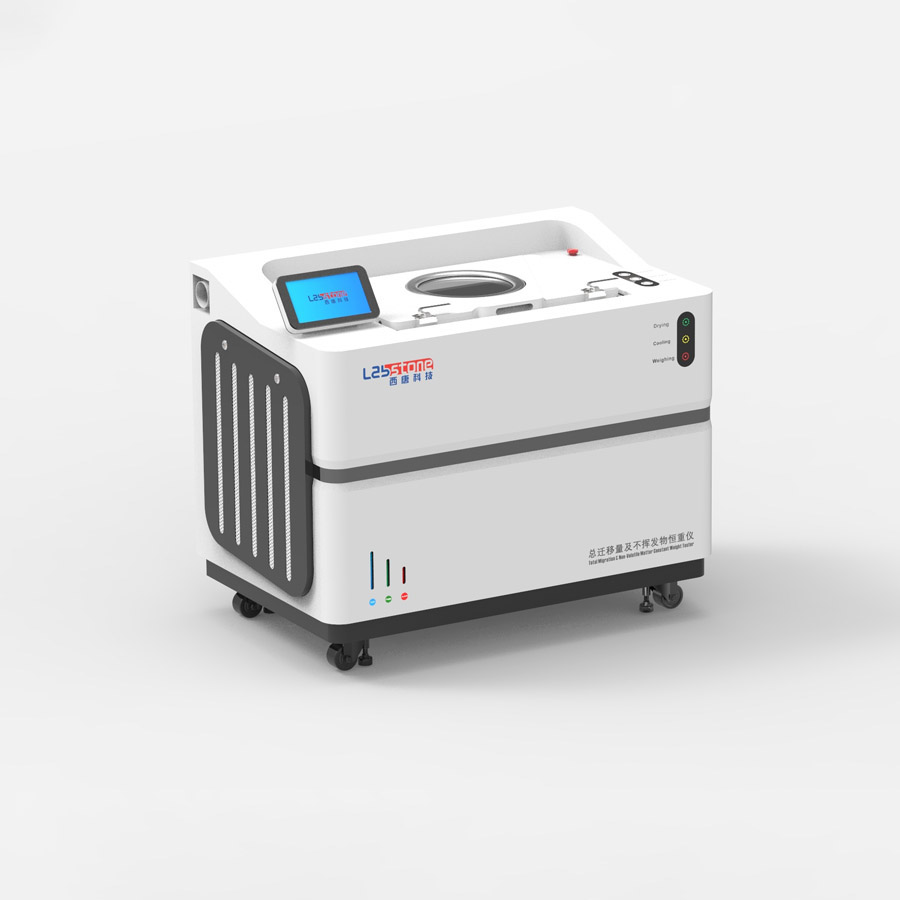
For a QC laboratory the practical bottleneck is the evaporate-to-constant-weight cycle. LabStone’s Overall Migration & Non-Volatile Residue Constant Weight Tester (ERT-C) chains water-bath evaporation at 105 °C, drying, cooling and constant-temperature weighing inside one sealed automated cabinet. Its differential mode weighs sample dishes against a reference dish carrying the blank, accepts constant weight only when successive weighings agree within 0.3 mg, and computes the residue automatically. Eliminating manual transfers, open dishes and desiccator handling removes the largest sources of loss and contamination, and produces batch-to-batch data that auditors can trace without re-derivation — exactly the evidence the extraction protocols demand. The payback is measurable: fewer repeat tests and tighter batch-to-batch variance, and procurement teams comparing testers should weigh the guaranteed constant-weight difference first, because that figure decides whether the results are citable.
References
- Pharmacopoeial extraction protocol for pharmaceutical laminated films: 600 cm² inner surface, water / 65% ethanol / n-hexane, 2 h immersion, 100 mL aliquots evaporated to dryness
- Material-level pass limit: residue difference versus blank not more than 30.0 mg for each of the three extracts
- Infusion-grade multi-layer co-extruded film: water extraction at 121 °C for 30 min; non-volatile residue limit 2.5 mg per 50 mL extract
- Ignited residue limit 0.05% and element-specific limits (Cu, Cd, Cr, Pb, Sn, Ba) for infusion film materials
- Constant-weight criterion: two successive weighings agreeing within 0.3 mg, based on a 0.1 mg readability balance