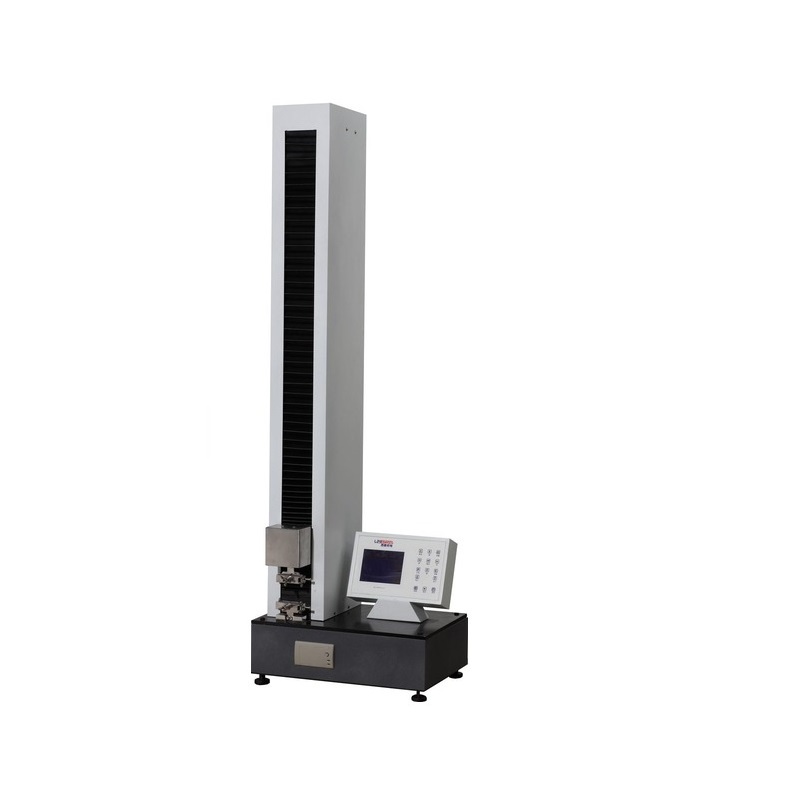
Peel strength measures how firmly the layers of a flexible laminated plastic hold together, and it decides whether a pouch delaminates, leaks or quietly loses its barrier properties. In the test, a specimen of defined width is pre-stripped for 50 mm, the two free legs are clamped in a tensile tester, and the layers are separated at constant speed in a T-peel or parallel peel configuration while the force curve is recorded. The result is the average peel force over the curve, expressed per unit width — most commonly newtons per 15 mm of specimen width. China's national peel method standard was revised in 2026: the new edition adds a parallel peel mode, expands specimen widths to six sizes between 10 and 50 mm, sets five speed steps from 100 to 500 mm/min and requires a grade-1 constant-speed testing machine. It takes effect on 1 December 2026, replacing the 1988 edition after 38 years.
1. Why peel strength decides laminate performance
A laminate works only as long as the adhesive bond holds its functional layers together: barrier layer, print layer and seal layer each do their job inside one structure. When interlayer bonding is weak, retort pouches bulge and delaminate after sterilisation, liquid-food packs weep at the edges, battery pouch foil cracks during deep drawing, and barrier performance degrades together with the separation of the layers. That is why peel strength is treated as the gold indicator of lamination quality, and why laminate converters run the peel test on incoming adhesive and film lots as well as during process qualification, after any change of corona treatment, coating weight, drying profile, lamination temperature or nip pressure. A weak interface is invisible from the outside — the pouch still looks intact on the shelf, so only a measured peel value can prove the bond.
2. Method principle and test conditions
The principle is a constant-speed T-peel: the specimen is pre-stripped along its length for 50 mm, the two free ends are clamped in the upper and lower grips so that the unpeeled part forms a T with the direction of pull, and the machine separates the layers at constant speed while recording the force curve. The 1988 edition prescribed a 15.0 ± 0.1 mm wide, 200 mm long specimen for laminated films, pulled at 300 ± 50 mm/min, and a 30.0 ± 0.2 mm wide, 150 mm long specimen for artificial leather and woven composites, pulled at 200 ± 50 mm/min, with specimens conditioned at 23 ± 2 °C and 45–55% relative humidity for at least 4 hours before testing. Five longitudinal and five transverse specimens are cut from each sample, the lamination direction being longitudinal.
| Aspect | 1988 edition | 2026 edition |
|---|---|---|
| Peel mode | T-peel only | T-peel plus new parallel-peel mode |
| Equipment | Tensile machine with graphic recorder | Grade-1 constant-speed testing machine |
| Specimen width | 15 mm and 30 mm | Six sizes: 10/15/20/25/30/50 mm |
| Test speed | Two steps: 200, 300 mm/min | Five steps: 100/200/250/300/500 mm/min, ±10% |
| Conditioning | 23 ± 2 °C, 45–55% RH, ≥4 h | Standard atmosphere, ≥24 h |
| Result rules | Approximate curve reading, two significant figures | Failure-type classification and curve-value rules |
3. Key changes in the 2026 revision
Equipment requirements move from a vaguely specified machine with a graphic recorder to a grade-1 constant-speed testing machine, with precise rules on grip alignment, anti-slip clamping and specimen protection — the main lever for reducing scatter between laboratories. Specimen widths grow from two to six standard sizes between 10 and 50 mm, all 200 mm long, so narrow strips and special laminate structures can be tested at the size that matches the product. Test speeds are set in five steps from 100 to 500 mm/min with a tolerance of ±10%, covering both highly extensible and low-strength structures, and conditioning follows the standard atmosphere for at least 24 hours, with separate provisions for moisture-sensitive specimens. Labs that already run a modern universal tester usually comply, but older frames with open-loop speed control typically do not, which makes an equipment audit the natural first step for every QC lab.
The revision also standardises the devices used for 90° and 180° peel, adds a wet-peel procedure and two chemical pretreatments for specimens that resist manual stripping, and introduces dedicated annexes for structures whose peel layer or a single layer is weaker than the bond itself. Result handling is tightened with a classification of specimen failure — adhesive-interface peel, cohesive failure of the adhesive, or substrate breakage — together with distinct value-reading rules for curves with identifiable peaks and for steadily fluctuating traces, plus a standard deviation calculation. The test report now specifies more than a dozen mandatory elements, including specimen preparation, conditioning conditions, failure type and a copy of the original force trace, which makes inter-laboratory data far more traceable than under the old edition. Annex procedures likewise give low-strength laminates a workable path to a valid number.
4. Expressing and judging the result
The result is the average peel force divided by the specimen width, most often reported in newtons per 15 mm; arithmetic means are calculated separately for the longitudinal and transverse groups, values are kept to two significant figures, and the standard deviation with maximum and minimum values is reported where needed. Interpretation starts from the failure type: adhesive-interface peel points to lamination or curing deficits, cohesive failure within the adhesive shows that the bond has outperformed the adhesive layer itself, and substrate breakage means the interface is stronger than the film, in which case the measured peel force is only a lower bound for the true bond strength. Lamination lines rarely bond identically in both directions, so longitudinal and transverse values are always reported side by side, and reading the curve class with the failure type is what turns a single figure into a process-diagnosis tool.
5. Boundaries against neighbouring standards
For pharmaceutical packaging, the monograph peel method applies, and it requires at least 8.0 N per 15 mm between the polyamide and aluminium layers of the laminate; the 2025 pharmacopoeia also carries a peel strength method for plastic materials. Peel of pressure-sensitive tapes follows its own adhesive-tape standard. Internationally, T-peel of flexible-to-flexible bonded assemblies is covered by ISO 11339, 180° peel of adhesive bonds by ASTM D903, and comparison of bond strength in laminate materials by ASTM F904. One boundary matters most in practice: peel strength measures the bond between layers inside the laminate, while seal strength as measured in ASTM F88 tests the welded closure of a finished pouch — a pack can seal perfectly yet still delaminate, so the two results cannot substitute for each other in a specification. Curing deficits usually appear first on foil-containing structures, which makes peel the most sensitive early-warning test in a converter's laboratory.
- China national peel method standard: published 25 May 2026, effective 1 December 2026, replacing the 1988 edition
- Specimens: six widths from 10 to 50 mm, 200 mm long, pre-stripped 50 mm, five longitudinal plus five transverse
- Speeds: five steps of 100/200/250/300/500 mm/min within ±10%; conditioning at the standard atmosphere for at least 24 h
- Results: average peel force per unit width (commonly N/15 mm), two significant figures, failure type reported
- International references: ISO 11339 (T-peel), ASTM D903 (180° peel), ASTM F904 (laminate bond comparison)