EN 1931 (EN 1931:2000) is the European standard 'Flexible sheets for waterproofing — Bitumen, plastic and rubber sheets for roof waterproofing — Determination of water vapour transmission properties'. It uses the desiccant cup gravimetric method: a specimen is sealed over an aluminium cup filled with desiccant, conditioned at 23°C and 75% RH, and weighed periodically until steady state. Results are expressed as the density of moisture flow rate g, moisture permeance, moisture resistance factor µ and the water vapour diffusion-equivalent air layer thickness sd.
1. Scope
The standard applies to factory-made bitumen, plastic and rubber flexible sheets for roof waterproofing and is the vapour-transmission test method behind CE marking type testing of these products. It is typically used alongside EN 1928 (watertightness), EN 12311-1/-2 (tensile properties) and EN 1849-1/-2 (thickness). Method A covers bitumen sheets; Method B covers plastic and rubber sheets.
2. Test assembly
The specimen is sealed to a cold-drawn aluminium cup with a free test area of 0.005 m². A layer of desiccant about 12 mm thick covers the cup bottom, leaving a 3–4 mm gap to the specimen. Weighing uses an analytical balance accurate to ±0.1 mg, and specimen thickness is measured with a mechanical gauge to 0.05 mm according to EN 1849.
3. Standard conditions and steady state
Under the default conditions the cup sits in a chamber at (23±1)°C and (75±2)% RH while the desiccant side is at about 0% RH (dry cup), with air movement of 0.02–0.3 m/s. Low-permeance specimens are weighed at weekly intervals; the compensated mass change (corrected with a blank assembly) is plotted against time, and steady state is reached when four consecutive points lie on a straight line with a deviation of at most 5%. A saturated sodium chloride solution at 23°C may be used to generate the constant humidity instead.
4. Result parameters
| Parameter | Meaning | Unit |
|---|---|---|
| g | Density of moisture flow rate | g/(m²·24h) or kg/(m²·s) |
| Π | Moisture permeance | g/(m²·24h·mmHg) or s/m |
| µ | Moisture resistance factor (vs air) | dimensionless |
| sd | Diffusion-equivalent air layer thickness | m |
5. Instrument selection
EN 1931 is a cup gravimetric method, so the critical capabilities are long-term temperature and humidity stability and high-precision periodic weighing. When comparing instruments, look for multi-chamber independent conditioning, automatic scheduled weighing (avoiding manual removal disturbances), an integrated ±0.1 mg balance, and automatic steady-state detection with linear fitting.
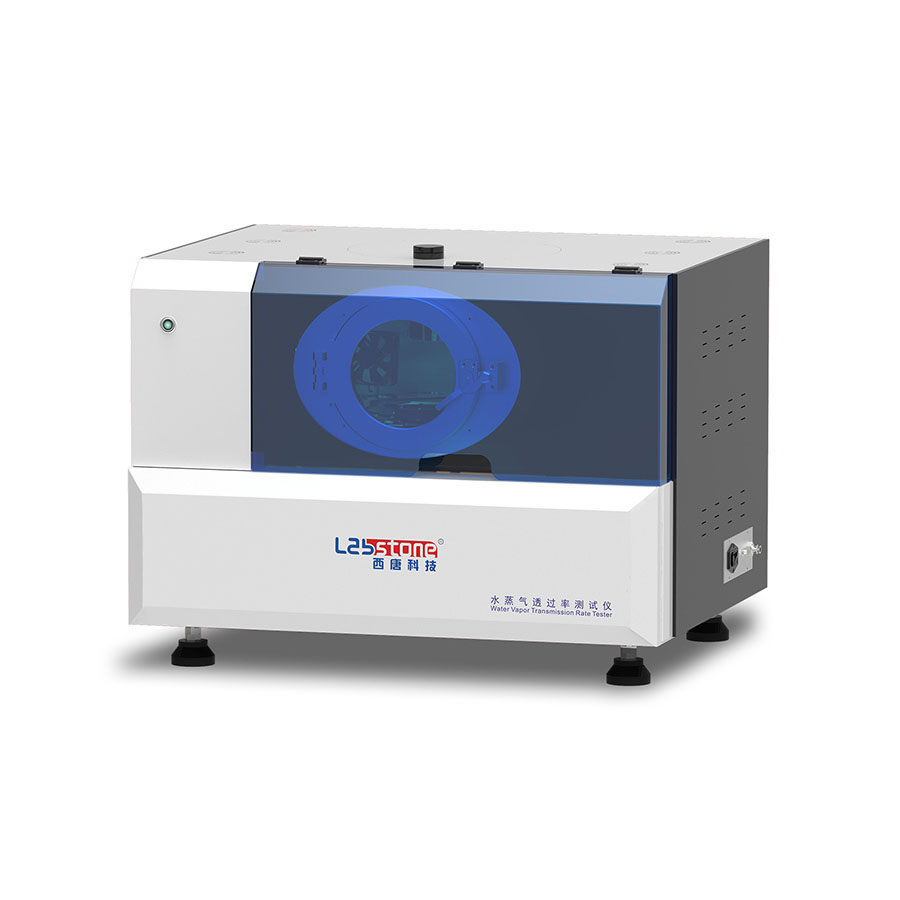
6. LabStone solution
The LabStone W-B-G series cup-method WVTR testers are built on the gravimetric principle with independently controlled chambers and automatic weighing and constant-weight judgement. They support EN 1931 Method A/B conditions as well as other cup-method standards such as EN 12086 and GB/T 1037.