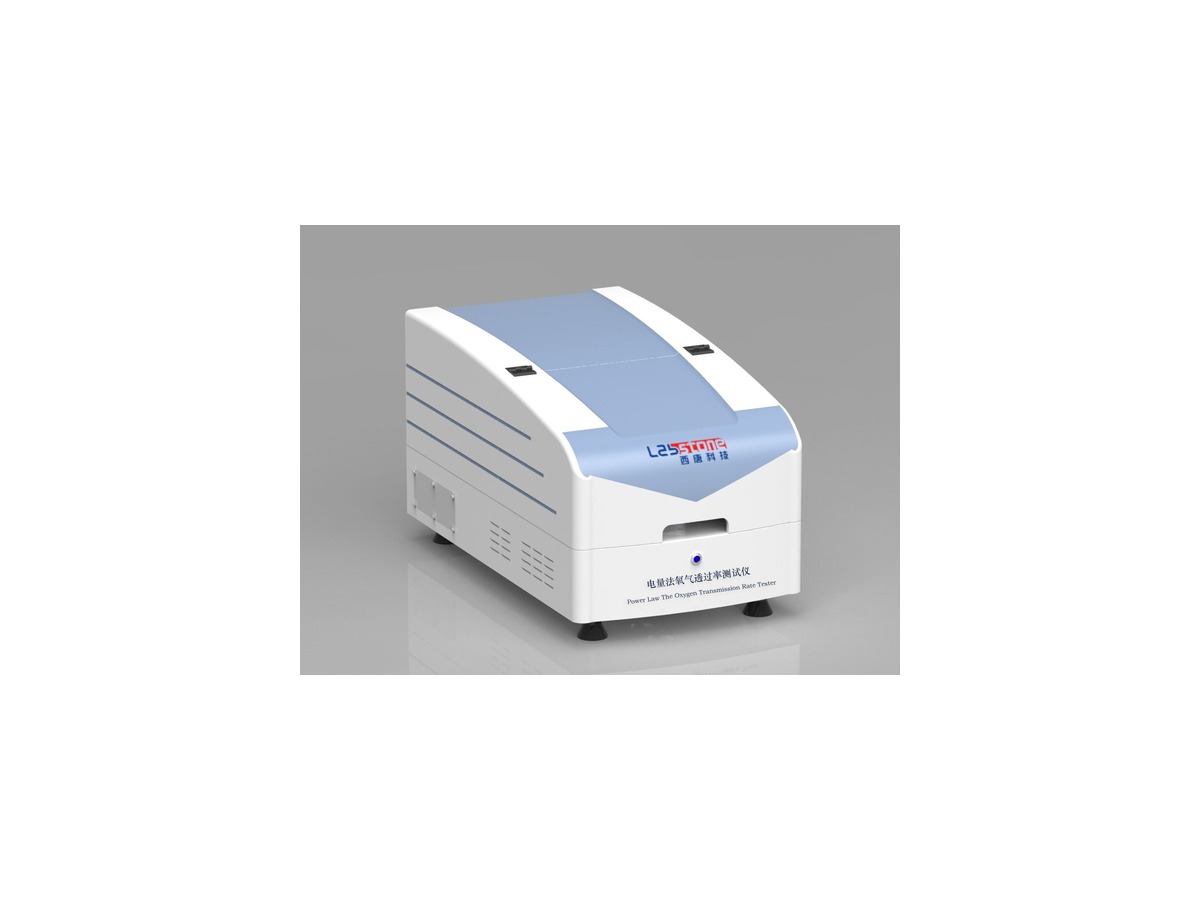
ASTM D3985 is the standard test method for the oxygen gas transmission rate (OTR) of plastic films, sheeting, laminates, coextrusions and plastic-coated paper or fabrics using a coulometric sensor, with the current edition designated D3985-24. The specimen divides a diffusion cell into two chambers: pure oxygen flows on one side while a nitrogen carrier gas sweeps the other, and the oxygen that permeates the film is quantified by a coulometric sensor working on Faraday's law. Once steady state is reached the instrument reads the transmission rate directly. Under the standard condition of 23 °C, 0% relative humidity and a 50 cm² test area, results are reported in cm³/(m²·day), together with oxygen permeance and, for homogeneous materials, the permeability coefficient. Because detection is absolute rather than comparative, the method is widely used for oxygen-sensitive food, pharmaceutical and medical packaging, where shelf life depends directly on oxygen ingress.
1. How the coulometric sensor turns oxygen into current
The coulometric sensor works on Faraday's law of electrolysis: every oxygen molecule entering the sensor takes part in an electrochemical reaction that releases a fixed quantity of electric charge, so the sensor current is directly proportional to the oxygen flux arriving from the film. This absolute relationship is why the sensor chemistry needs no empirical calibration curve, and in practice it distinguishes coulometric detection from relative sensor methods, where every reading depends on the assumed value of a calibration film. The carrier gas is nitrogen containing 0.5 to 3.0 percent hydrogen with no more than 100 ppm oxygen — the small hydrogen fraction keeps the sensor cathode in its reduced, active state — while the test gas is oxygen of at least 99.5 percent purity. Detection is continuous and non-destructive, so the instrument can watch the signal climb and confirm exactly when the specimen reaches steady-state permeation.
2. Specimens and the standard test conditions
The exposed test area in the diffusion cell is 50 cm², specimen thickness is recorded as the average of at least five measurements, and specimens with wrinkles, creases or pinholes are disqualified. The current edition requires preconditioning the specimens in a desiccator for at least 48 hours, because the standard condition is 23 °C and 0% relative humidity with temperature controlled to within ±0.5 °C; other temperature and humidity combinations are permitted by agreement. That option matters for moisture-sensitive barriers such as EVOH, whose oxygen transmission rises sharply at high relative humidity. The dry default often surprises laboratories used to WVTR work at 90% RH — for OTR the standard condition deliberately isolates the film from moisture so that results stay comparable between laboratories. Reporting the conditioning and test conditions alongside every result is part of the method, since OTR values taken at different humidity levels are not interchangeable.
The run starts with purging: both cell chambers are flushed with nitrogen at 50 to 60 mL/min for 3 to 4 minutes to remove air, the carrier flow is then reduced to 5–15 mL/min and held for 30 minutes, and the zero reading E0 is recorded. Oxygen is next switched onto the test-gas side — a flow around 60 ± 10 mL/min is typical — and the sensor current climbs until it stabilises at Ee. OTR follows from OTR = (Ee − E0) × Q / (A × RL), where Q is the system constant, A the test area and RL the leak correction, reported in cm³/(m²·day). Thin films with high diffusion coefficients reach steady state within 30 to 60 minutes, while thicker or more complex structures commonly need several hours before the reading settles.
3. Calibration, quality control and typical results
System calibration uses certified reference films traceable to NIST to establish the instrument constant, and the method expects sensor efficiency to sit in the 95 to 98 percent band. A routine leak check runs an oxygen-impermeable metal foil as the specimen: a healthy system reads essentially zero. Interlaboratory data published with the method show OTR values of roughly 0.06 cm³/(m²·day) for aluminized PET and about 0.30 for an EVOH laminate with good repeatability and reproducibility — figures that also illustrate the dynamic range coulometric detection covers, from high-barrier metallised structures up to uncoated films several orders of magnitude higher. These checks belong in every laboratory routine: a sensor drifting out of its efficiency band or a leaking cell seal produces plausible-looking numbers that quietly overstate or understate the true barrier performance of the film.
4. Choosing between equal-pressure and differential-pressure methods
ASTM D3985 is an equal-pressure method: both sides of the film sit at ambient pressure, the driving force is the partial-pressure difference of oxygen, and the specimen carries no mechanical stress — which suits thin and high-barrier materials. Its international counterpart is ISO 15105-2, the equal-pressure method with a coulometric detector. Differential-pressure methods such as ASTM D1434 or ISO 2556 pull a vacuum or apply pressure on one side to create roughly one atmosphere of driving force; very soft films can deform, and the vacuum-side conditions are hard to reconcile with real packaging. An equivalent national coulometric standard serves the same arbitration role for laminated films and pouches in China's product standards. Both approaches report the same physical quantity, so cross-method comparison tables are common in supplier datasheets. Whichever method is chosen, it must match the customer specification and be stated by number in the test report.
- ASTM D3985-24: coulometric sensor method for the oxygen transmission rate of plastic films, sheeting and laminates
- Standard condition: 23 °C, 0% RH, temperature within ±0.5 °C, 50 cm² test area, dry preconditioning ≥48 h
- Carrier gas: nitrogen + 0.5–3.0% hydrogen (≤100 ppm oxygen); test gas: oxygen ≥99.5%
- Sequence: purge 50–60 mL/min for 3–4 min → carrier 5–15 mL/min, hold 30 min → E0 → oxygen on → Ee
- OTR = (Ee − E0) × Q / (A × RL) in cm³/(m²·day); metal-foil leak check should read ≈ 0
- International counterpart ISO 15105-2; an equivalent national coulometric standard serves as the arbitration method for laminated films