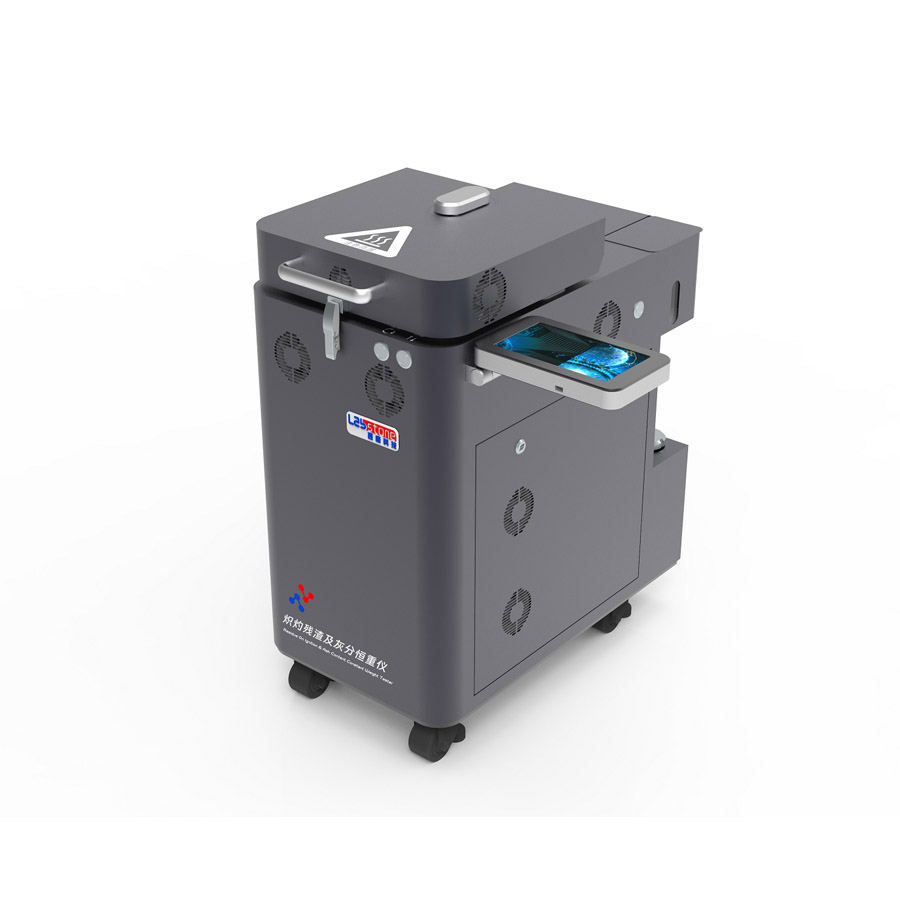
Ash determination means burn the sample to ash and weigh how much ash remains. The inorganic matter that will not burn, salts, oxides, minerals, stays behind as ash, and its percentage of the original sample is the ash content.
Think of burning a spoonful of milk powder: what remains as a little white powder is the ash, reflecting how much mineral or inorganic matter was present.
Method categories
1) Total ash: residue from direct high-temperature ashing (usually 550–600 °C). 2) Acid-insoluble ash: the part of total ash not dissolved by hydrochloric acid. 3) Water-soluble ash: the part of total ash soluble in water. 4) Crude ash (feed/food): a direct ashing method similar to total ash.
Formula
Total ash(%) = (m_ash - m_crucible) / m_sample x 100%. The constant-weight criterion is the same as for residue on ignition (inter-cycle difference below 0.3 mg, based on a 0.1 mg balance).
Relation to residue on ignition
Both ash determination and residue on ignition measure the inorganic residue after ignition; they differ in whether sulfuric acid is added, the temperature, and the sample type (food/herb vs drug substance). The IRT-A covers both with one instrument.