
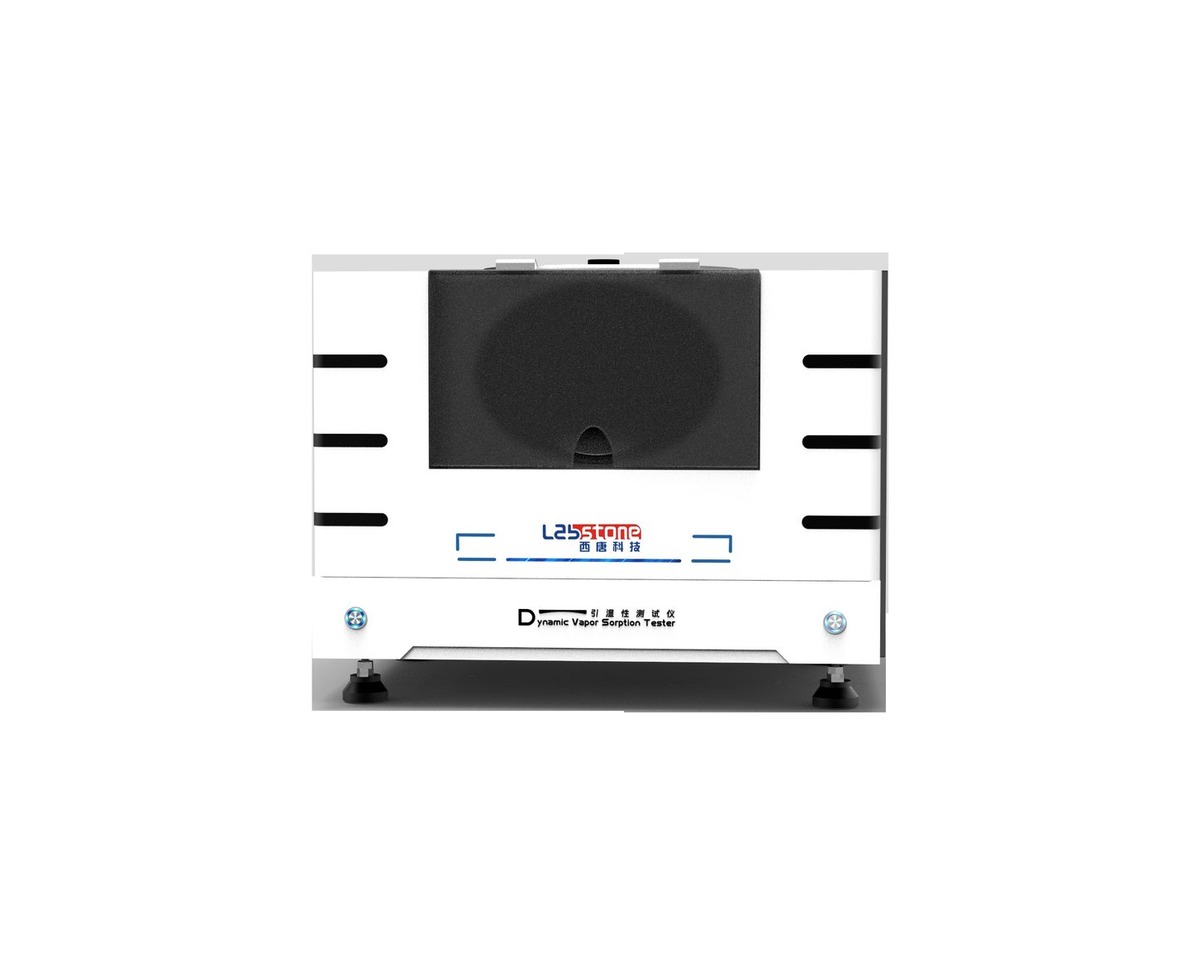
Dynamic Vapour Sorption Analyser (DVS)
Continuously weighs samples under precisely controlled humidity and automatically plots sorption/desorption isotherms for API hygroscopicity classification, excipient moisture-sensitivity studies and packaging selection.
Purpose | What it does for you
Continuously weighs samples under precisely controlled temperature and humidity to plot sorption and desorption isotherms — used for API hygroscopicity classification (e.g. European/Chinese Pharmacopoeia hygroscopicity tests), excipient moisture-sensitivity studies, salt/polymorph screening and packaging or storage selection. Unlike a single-point loss-on-drying result, DVS reveals continuous water uptake across the whole humidity range, exposing hysteresis, deliquescence points and critical relative humidity — information essential to formulation and stability design.
Key Features
- High-sensitivity balance with continuous weighing and automatic sorption/desorption isotherms
- Programmed humidity steps with automatic equilibration judgement before each next step
- Automatic calculation of moisture uptake, hysteresis and critical relative humidity
- Multiple workstations available, supporting simultaneous reference samples
- Graphical full-process monitoring and multi-format reports; optional GMP Computerized System module
Operating Principle
The sample sits on a pan inside a high-sensitivity balance within a thermostatted chamber. The system steps the relative humidity through a programmed profile (e.g. 0→95% RH in steps), recording mass continuously at each step until equilibrium; humidity is then stepped down to record the desorption branch. Equilibrium masses at each RH give the sorption/desorption isotherm, from which moisture uptake, hysteresis and critical relative humidity are derived.
Technical Specifications
| Humidity Range | programmable (typ. 0–95% RH) |
|---|---|
| Temperature Range | programmable (typ. 15–45 ℃) |
| Balance Resolution | 0.1 mg (by configuration) |
| Specimen Count | 51 / 111 / 231 by model |
| Power Supply | AC 220/110 V ±10%,50/60 Hz |
Note: Due to continuous product iteration and varying application conditions, the technical parameters on this page are typical reference values and are not to be used as acceptance criteria. For tender and customized projects, the product model, configuration and specifications are subject to the mutually confirmed technical agreement and the actual delivered product. For parameter matching tailored to your specific project, please contact us.
Models & Configuration
| Model | DVST-51 | DVST-111 | DVST-231 |
|---|---|---|---|
| Specimen Count | 51 | 111 | 231 |
Standard Configuration
Main unit, sample pans, computer, professional software, humidity generation and control unit. Final scope per the confirmed technical specification.
Application Scenarios
- API hygroscopicity classification (pharmacopoeia hygroscopicity test)
- Moisture sensitivity studies of excipients and formulations
- Polymorph and salt screening plus deliquescence point determination
- Basis for selecting packaging materials and desiccant quantities
Compliance Standards
Industries Served
- Pharmaceutical & Biopharmaceutical
- Cosmetics & Personal Care
- Food & Condiments
- Material R&D, Universities & Institutes
- Third-Party & Government Testing Institutes
- Traditional Chinese Medicine & Herbal
Frequently Asked Questions
How long does a full DVS isotherm take?
It depends on the number of humidity steps, the equilibrium criterion and the sample's own sorption kinetics — typically several hours to one or two days. The instrument judges equilibrium automatically and advances unattended; multi-station models run several samples in parallel, greatly improving throughput.
Does LabStone support OEM/ODM and customised instruments?
Yes. Standard models ship as-is, while chamber count, specimen size, fixtures, temperature range and software modules (including the GMP Computerized System module) can be tailored to your SOP and URS. IQ/OQ/PQ validation documentation packages are available.
What is the typical lead time, and how is shipping handled?
Standard models usually ship in 4–8 weeks; customised builds depend on the agreed scope. Instruments are packed in export wooden cases and can move by sea, air or rail. We supply proforma invoice, packing list and certificate of origin (CO / Form E), and work under EXW, FOB, CIF or DAP terms.
How are installation, training and calibration handled after delivery?
We provide remote installation guidance, bilingual (Chinese/English) manuals and video training; on-site commissioning by our engineers is available. Users can self-calibrate with standard weights, reference films or calibrated leak standards, and third-party calibration certificates can be supplied.
What is the warranty, and how are spare parts supplied?
The instrument carries a 12-month warranty from acceptance plus lifetime maintenance support. Consumables (molecular sieve, desiccant, sealing grease, printer paper) are kept in long-term stock, and key components are international brands available worldwide. We respond to technical enquiries within 24 hours.
Do the instruments comply with ASTM, ISO and pharmacopoeia standards?
Yes. Every instrument lists its applicable standards on the specification page (ASTM, ISO, GB, YBB, Chinese Pharmacopoeia, USP, EP, JIS, DIN, TAPPI and more). The software outputs raw records and reports suitable for audit trails, with an optional GMP / FDA 21 CFR Part 11 compliance module.
Which languages does the software support, and can it integrate with a LIMS?
The software ships with Chinese and English interfaces; other languages can be added on request. Data export is available over RS232, USB, Ethernet or Wi-Fi, and reports can be exported to Excel, PDF or structured files for LIMS integration.