Extractables testing is something almost no pharmaceutical packaging manufacturer can avoid. Many assume it is much like a routine overall-migration test, yet when the regulator audits the data, non-compliant results keep appearing. Drawing on YBB 00342004, this article spells out the core requirements of this test.
Determination of non-volatile matter in extractables is a safety screening aimed specifically at packaging that contacts the drug directly. Once plastic vials for injections, aluminium–plastic blister packs or butyl rubber stoppers are in long-term contact with the drug, small-molecule additives and residual substances gradually leach into it. If the total non-volatile matter released exceeds the limit, it can at best cloud the drug and at worst react with it, altering efficacy or even producing toxic substances — which is why this is a mandatory item in registration and release testing of pharmaceutical packaging.
The compliant procedure: from medium selection to constant weight
YBB 00342004 sets out a clear procedure. First, choose the extraction medium according to the packaging's actual use — purified water for injection packaging, an acid solution of the matching pH for acidic drugs, ethanol for drugs dissolved in organic solvents — and soak under the specified temperature and time so that the soluble substances fully leach out.
Then collect the entire extract, evaporate it to dryness in a dish on a water bath, dry it in a 105 °C oven to constant weight, cool and weigh, subtract the residue of the blank medium, and calculate the total non-volatile matter in the extractables against the specification limit.
The pitfalls of manual operation
The evaporation and constant-weight steps are where manual work most often fails. Extractables levels are usually very low, so a small operating error pushes the result beyond the limit. During manual water-bath evaporation, dust falling in or an unclean dish raises the blank; a little spatter of residue during evaporation lowers the result — either way, the whole batch can be invalidated. Manually only a dozen or so samples can be handled at once, and the sample must be transferred repeatedly from evaporation to drying and weighing, which is slow and error-prone.
How automation keeps the test compliant
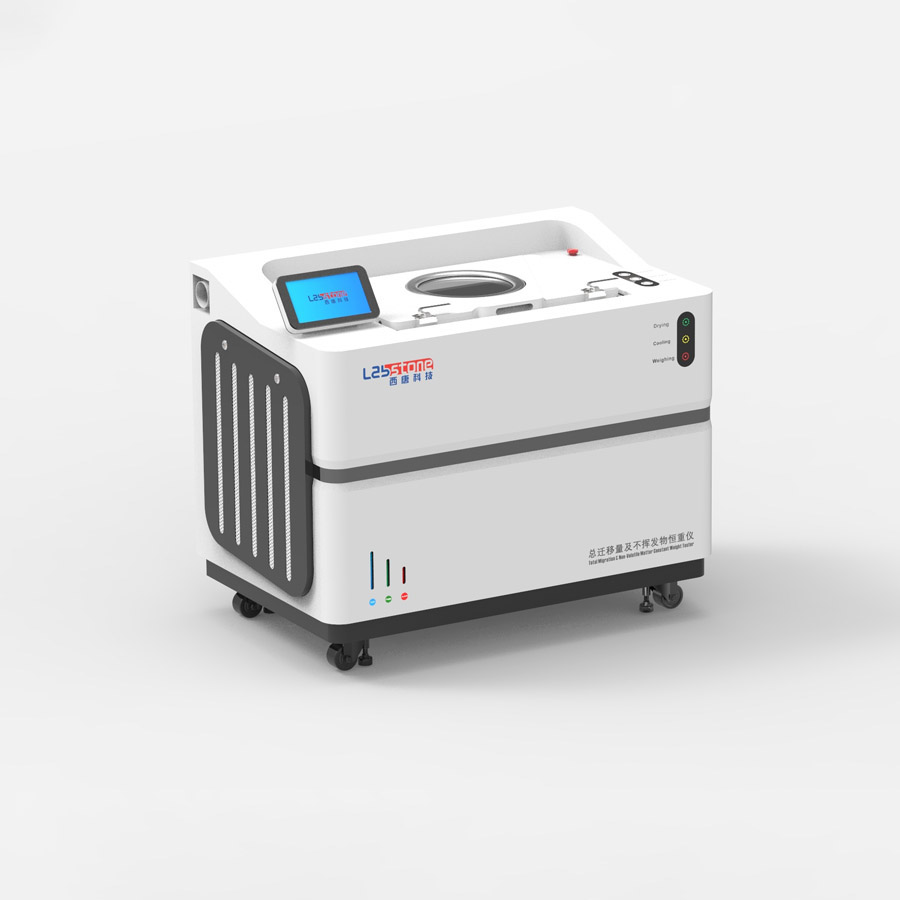
A fully enclosed, integrated overall-migration and non-volatile-matter constant-weight system combines water-bath evaporation, drying, cooling and weighing in one enclosed automated workflow, so no external dust enters and no manual sample transfer is needed.
The instrument evaporates the extract on a temperature-controlled water bath to dryness, then dries to constant weight automatically until two consecutive weighings meet the standard, then cools and weighs and computes the result. Up to 69 samples can be tested in one batch with no operator attendance; replicate deviation is far below the standard limit, and compliant data is delivered directly.
Conclusion
Non-volatile-matter testing in extractables is the gatekeeper of pharmaceutical packaging safety. Replacing manual evaporation, drying and weighing with automated constant weight removes blank contamination and spatter loss at the source, so every registration and release test stays reliably within limits.