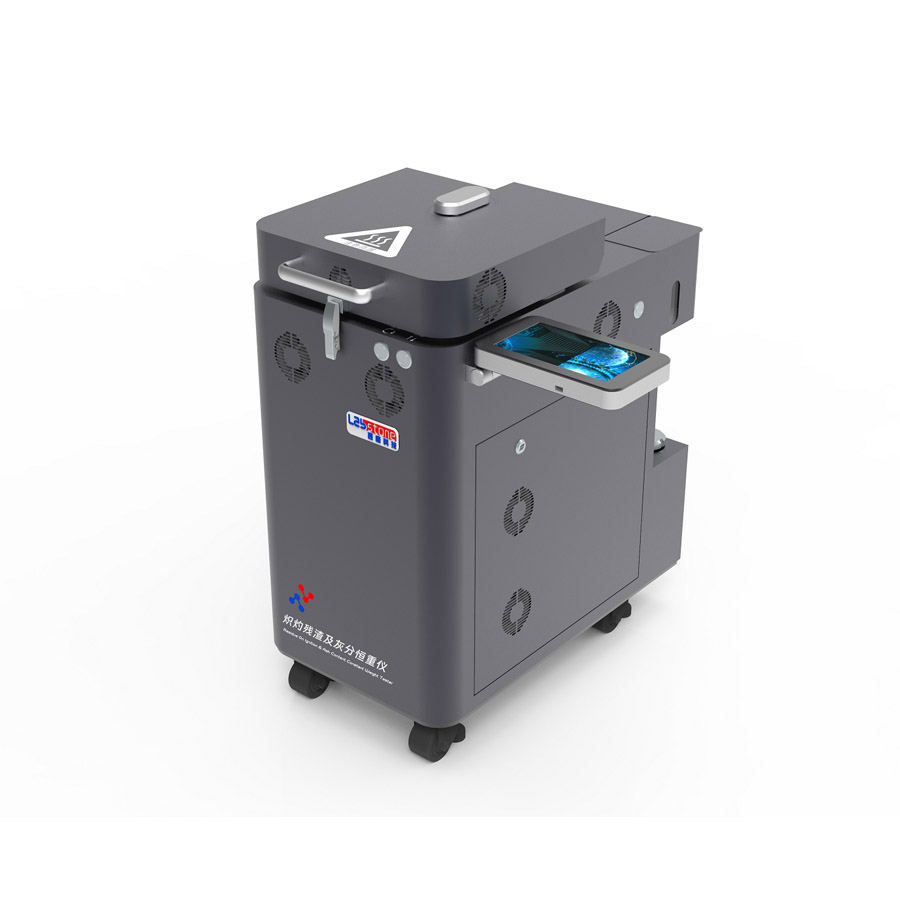
Ash content is the inorganic fingerprint of a pharmaceutical rubber closure. The pharmacopoeial rubber ash method calls for 1.0 g of cut sample, placed in a crucible previously ignited to constant weight and weighed precisely, carbonized gently over an electric hot plate without letting the sample flame, and then ignited in a furnace at 800 °C ± 25 °C until the residue is fully ashed and the crucible has returned to constant weight. The ash percentage is calculated as the residue mass divided by the sample mass, with the empty crucible as the reference, and acceptance limits are set in the material-specific monographs rather than in the method standard itself. In practice the figure reflects formulation consistency: mineral fillers such as kaolin and titanium dioxide, together with activators like zinc oxide and magnesium oxide, dominate the residue left behind after ignition.
1. Why ash matters for pharmaceutical closures
Halogenated butyl and polyisoprene closures are compounded with mineral fillers such as kaolin and titanium dioxide, together with functional additives like zinc oxide, magnesium oxide and calcium carbonate, so the ash level is a direct window into formulation consistency and batching discipline. A drifting ash value signals filler variation, a shifted cure system or contamination entering through raw materials, and each of these faults erodes the long-term compatibility between the closure and the drug product it protects. Inorganic residue can also seed visible particulates and change the extractables profile of the package. Because the closure belongs to the container-closure system assessed in regulatory filings, ash sits on the baseline release panel for every elastomeric formulation change, for incoming raw material lots and for stability programmes, which is why laboratories run it alongside moisture and extractables rather than in isolation.
2. The method, step by step
Cut the sample into small pieces and weigh exactly 1.0 g into a crucible previously ignited to constant weight and weighed precisely. Carbonize gently over an electric hot plate, taking care that the sample never flames, because open burning loses organic mass as smoke and biases the residue low. Cool the crucible, then transfer it to a furnace held at 800 °C ± 25 °C and ignite until the residue is fully ashed. Remove the crucible, cool it in a desiccator to room temperature and weigh it precisely, then re-ignite at 800 °C ± 25 °C to constant weight to obtain the final ash mass. The calculation divides the residue mass by the sample mass and expresses the result as a percentage, using the empty crucible as the reference point. Cutting the sample into pieces of at most a few millimetres helps the carbonization proceed evenly and keeps the final ash representative of the whole stopper.
| Item | Requirement |
|---|---|
| Sample mass | 1.0 g, cut into small pieces |
| Carbonization | Gentle ignition over a hot plate, no open flame |
| Ignition temperature | 800 °C ± 25 °C |
| Endpoint | Ignition to constant weight |
| Cooling | In a desiccator, then weigh precisely |
| Calculation | Ash % = (m2 − m1)/m0 × 100% |
3. The constant-weight criterion
Constant weight means two successive weighings agreeing within 0.3 mg, a criterion premised on a 0.1 mg resolution balance. At 800 °C the crucible must travel repeatedly between furnace and desiccator, and every transfer adds risk: incomplete ashing, moisture pickup through an overloaded desiccator, fingerprints or dust landing on hot glassware, and cooling times that vary from run to run. Each of these effects enters the weighed result directly, which is why handling scatter, not furnace temperature, is the main source of between-run variability in ash data. It is also exactly what an auditor probes first when a certificate of analysis is reviewed: how long the crucibles cooled, whether the balance was verified, and how the laboratory documented that the endpoint had actually been reached. An overloaded desiccator or an unlabelled crucible can invalidate an entire run, which is why most laboratories fix the cooling time and the desiccator load in a written procedure.
4. A revision under way: fixed 2-hour ignition
A published draft revision of the rubber-seal ash method changes the endpoint from ignition to constant weight to a fixed 2-hour ignition at 800 °C ± 25 °C, and requires the sample to be cut into pieces no larger than 5 mm so that the result is more controllable; material-specific acceptance limits move into the product monographs. The stated aim is efficiency: a fixed soak at temperature replaces repeated cooling-and-weighing cycles while still satisfying the limit check that the monograph actually applies. The published method standard still ends at constant weight, so laboratories should state which method basis and which endpoint they applied whenever ash values are reported, and keep the two versions separate in the test report. Piece size matters as well: smaller granules carbonize evenly, so the fixed two-hour soak stays representative of the whole stopper rather than of its surface only.
5. How it differs from neighbouring methods
The pharmacopoeial residue-on-ignition test wets the carbonized sample with sulfuric acid and ignites it at 700–800 °C, a protocol intended for the drug substance itself rather than for closure ash; the acid step converts volatile metal species to stable sulfates so the residue can be weighed reliably. For rubber materials in general, ISO 247 is the international reference method for the determination of ash, with its own sample preparation and temperature options. The closure ash method described here uses no sulfuric acid and fixes the furnace at 800 °C ± 25 °C. Because sampling mass, endpoint and temperature all differ across these three routes, an ash value is only comparable within the method that produced it, and the method basis must always be cited when results are reported. In daily QC practice the closure ash method and the residue-on-ignition test therefore answer different questions and should not be interchanged.
- Pharmacopoeial rubber ash method: 1.0 g cut sample, gentle carbonization, ignition at 800 °C ± 25 °C to constant weight, ash % = (m2 − m1)/m0 × 100%
- Draft industry revision: pieces no larger than 5 mm, fixed 2-hour ignition at 800 °C ± 25 °C, limits moved to product monographs
- Residue on ignition (general chapter 0841): sulfuric acid wetting, ignition at 700–800 °C, intended for drugs
- ISO 247: international reference method for the determination of ash in rubber
- Constant weight: two successive weighings within 0.3 mg, based on a 0.1 mg resolution balance