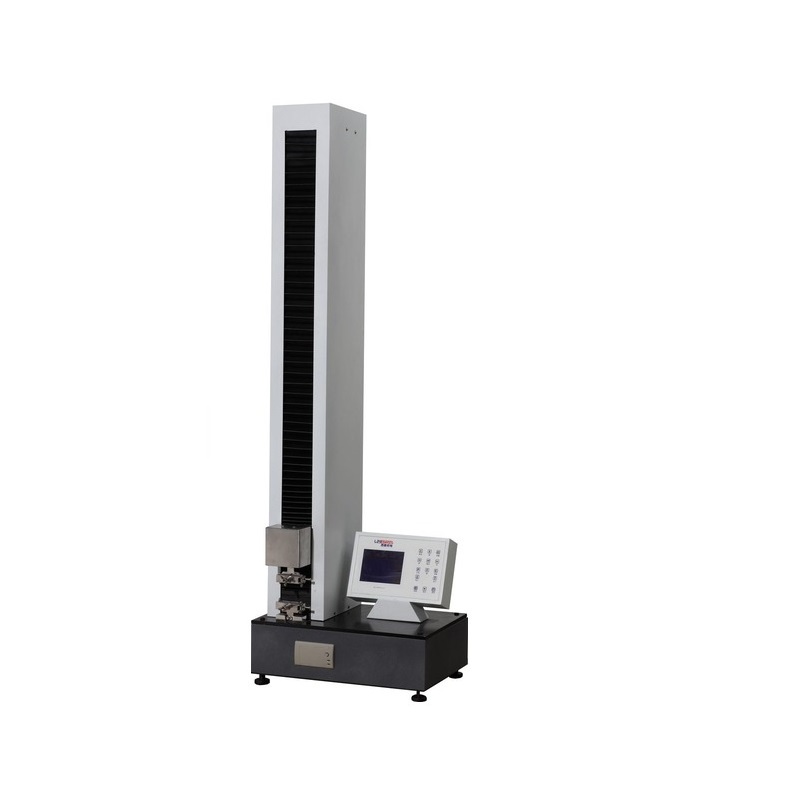
ASTM D882, 'Standard Test Method for Tensile Properties of Thin Plastic Sheeting', is the reference method for uniaxial tensile testing of plastic films and sheeting up to 1.0 mm (0.04 in) thick. Rectangular strips 25.4 mm (1 in) wide are pulled at a constant crosshead speed until failure, reporting tensile strength, yield strength and strain, elongation at break and modulus of elasticity, expressed in MPa or psi. Plastics thicker than 1.0 mm must be tested to ASTM D638 instead.
1. Scope
The method serves the flexible packaging, agricultural and industrial film industries: multilayer barrier films, heat-seal layers, stretch wrap and mulch films all rely on tensile data to control strength and handling behaviour. ASTM D882 measures the film material itself — not seal strength, barrier properties or package integrity — so in a finished-package release file it complements rather than replaces tests such as ASTM F88, ASTM F2054 and the WVTR/OTR methods.
2. Specimen preparation
Specimens are rectangular strips 5.0–25.4 mm wide, with 25.4 mm standard, and each strip must be at least 50 mm longer than the grip separation. The standard gauge length is 250 mm; where sample size prevents this, a minimum 50 mm gauge is acceptable provided it is shown not to affect the results. Thickness is measured at several points along the gauge per ASTM D374 and the minimum value is used for stress calculation; thickness must be uniform to within 10% between the grips, or 5% near the 1 mm limit.
3. Conditioning and specimen count
Before testing, samples are conditioned for at least 40 hours at 23 ± 2 °C and 50 ± 5% RH per ASTM D618. At least five specimens are tested from each isotropic sample; suspected anisotropic films — blown and cast film in particular — require ten, five in the machine direction (MD) and five in the transverse direction (TD). Specimens used for modulus determination cannot be reused for tensile strength or any other property, so prepare extra strips.
4. Test speed
The crosshead speed is set by multiplying the initial strain rate by the gauge length: stiff films that break at low elongation use a lower rate (typically 50 mm/min), highly extensible films such as stretch wrap run at up to 500 mm/min, and modulus tests always use the slow rate. Because thin films slip easily, the standard recommends pneumatic grips and a small preload to remove initial slack — without it, the whole stress–strain record is distorted.
5. Results and anisotropy
The method reports tensile strength, yield strength and yield strain, elongation at break and modulus of elasticity; for films, a secant modulus at 1% or 2% strain is commonly used as a practical stiffness measure. Oriented films differ sharply between MD and TD, so both directions must be tested and reported separately — a single direction never represents the roll. High within-batch scatter usually points to thickness variation or uneven orientation and is an early warning from the extrusion line.
6. LabStone solution
The LabStone STR-A auto tensile tester covers the small force range of packaging films, with pneumatic grips and programmable speed; preload, gauge length and speed are preconfigured for one-click ASTM D882 or ISO 527-3 methods, and it computes strength, elongation and modulus automatically while recording the full force–displacement curve. Flexible-packaging plants use it as a single bench for MD/TD tensile qualification of incoming and finished films.