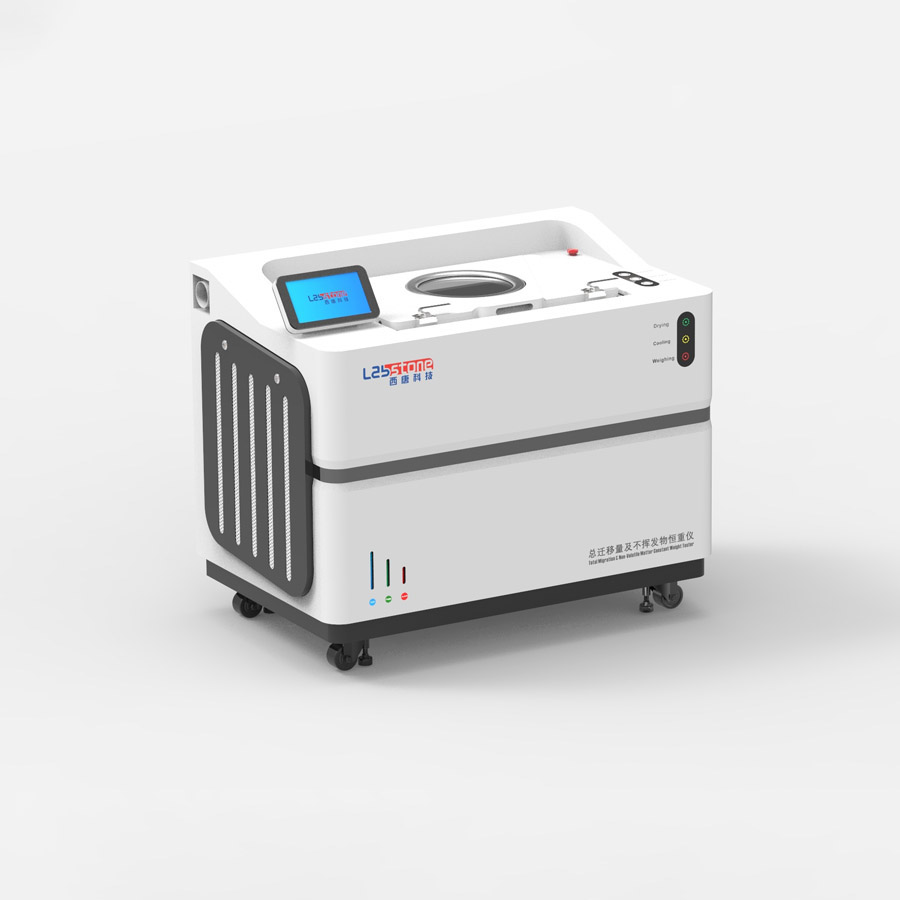
Overall migration (OML) and non-volatile residue (evaporation residue) are in principle the same gravimetric method: the migrated substances are transferred into a dish, the solvent is evaporated off, the residue is dried to constant weight and weighed, and the result is normalised by contact area or by sample mass. The basis is the national method standard for the determination of overall migration of food contact materials and articles, read together with the product regulation that sets the limit at 10 mg/dm² and 60 mg/kg for infant food contact materials expressed per kilogram of food; the international counterparts are Regulation (EU) No 10/2011 and the gravimetric methods of the EN 1186 series. Three controls decide whether the result can be trusted: the blank correction, bringing the evaporating dish to constant weight beforehand, and the constant-weight criterion itself — the method standard sets a limit of 0.5 mg on the mass difference between two successive weighings, while the LabStone system works below 0.3 mg.
1. Total migration, non-volatile residue and loss on drying are three ways of asking
Total migration answers how much non-volatile matter migrated into the food, normalised by contact area to mg/dm². Non-volatile residue and evaporation residue answer how much residue there is, expressed per volume of test solution or per mass of sample. Loss on drying answers what share of the mass was moisture. All three use the same constant-weight tester and the same "dry to constant weight" criterion; they differ only in sample preparation and in how the result is normalised.
2. How the standards are layered: limits, general rules, method
The framework has three layers. The regulation sets the limit — 10 mg/dm² overall migration, with a 60 mg/kg limit for plastic materials and articles for infant food expressed per kilogram of food, and points to the determination method. The general rules for food contact materials set the food simulants and the immersion conditions. The determination method standard gives the gravimetric step-by-step procedure: transfer of the immersion liquid into a pre-weighed dish, evaporation on a water bath, drying to constant weight and the final calculation. For pharmaceutical packaging and medical devices, the equivalent chemical characterisation framework is ISO 10993-18:2020.
3. The workflow: from simulant to mg/dm²
Step one is simulant selection: aqueous food (pH above 4.5) uses distilled water, acid food (pH 4.5 or below) uses 4 % acetic acid, alcoholic food uses 10 % or 20 % ethanol, fatty food uses olive oil or, where permitted, isooctane or 95 % ethanol as a substitute, and the most onerous simulant is chosen. Step two is the immersion: the standard conditions cover long-term room storage at 40 °C for 10 days, short-term storage up to 24 h at 40 °C for 24 h, refrigerated storage at 20 °C for 10 days, frozen storage at 5 °C for 10 days, hot filling or pasteurisation at 70 °C or 100 °C for 2 h, and high-temperature sterilisation at 121 °C for 1 h, never exceeding the deformation temperature of the material. The immersion area-to-volume ratio is generally 6 dm² to 1 L, that is 100 mL per 1 dm².
| Contact condition | Immersion temperature and time |
|---|---|
| Long-term room storage | 40 °C × 10 d |
| Short-term storage (≤ 24 h) | 40 °C × 24 h |
| Refrigerated | 20 °C × 10 d |
| Frozen | 5 °C × 10 d |
| Hot filling / pasteurisation | 70 °C or 100 °C × 2 h |
| High-temperature sterilisation | 121 °C × 1 h |
4. The constant-weight criterion: 0.5 mg is the regulatory threshold, 0.3 mg is the automation margin
Constant weight is the single step that determines whether the result can be trusted, and the standard specifies it tightly. The procedure: wash and drain the evaporating dish, dry it for 2 h in an electric constant-temperature drying oven at 100 °C ± 5 °C, cool it for 0.5 h in a desiccator and weigh it; drying, cooling and weighing are repeated until constant weight is reached, and constant weight is defined as a mass difference between two successive weighings not exceeding 0.5 mg. The cycle is run twice over — once for the empty dish and once for the dish carrying the residue — and both must satisfy the 0.5 mg limit. The matching instrument requirements are given in the equipment clause: an electric constant-temperature drying oven with a temperature control accuracy of ±5 °C, and an analytical balance with a readability of 0.1 mg. The balance readability has to be better than the constant-weight criterion, otherwise a 0.5 mg difference cannot be resolved at all.
The 0.5 mg figure is a regulatory threshold, not a recommendation: to declare constant weight the laboratory has to stay within 0.5 mg, and loosening the criterion to 1 mg is not defensible under the standard. An automated constant-weight system that judges at 0.3 mg keeps a margin that works in both directions. First, when weighing repeatability is good the criterion is still reached reliably, so a random 0.4 mg fluctuation does not stall the cycle. Second, the smaller the constant-weight difference, the smaller the systematic bias in the residue mass — which matters most when the overall migration limit is 10 mg/dm² while the residue itself may weigh only a few milligrams. Automation also removes a class of error that manual weighing invites: repeatedly carrying a hot dish between oven, desiccator and balance lets residual heat and condensed moisture affect the reading.
5. The precision clause: how constant-weight error propagates into the reported result
The precision clause ties the constant-weight step directly to the reported result in two tiers. When the overall migration result is not greater than 10.0 mg/dm² or 60.0 mg/kg, the difference between two independent determination results obtained under repeatability conditions and their arithmetic mean must not exceed 1.0 mg/dm² or 6.0 mg/kg. When the result exceeds 10.0 mg/dm² or 60.0 mg/kg, that difference must not exceed 10 % of the arithmetic mean. Results after applying a correction factor must still satisfy the requirement. The point to note is what the clause judges: the difference between each result and the mean, not the absolute difference between the two parallel determinations — the latter is twice the former, and laboratories checking their own precision routinely confuse the two. The clause also explains why the standard holds the constant-weight criterion at 0.5 mg: near the 10 mg/dm² limit only 1.0 mg/dm² of spread is allowed, so every extra 0.5 mg of uncertainty admitted at the constant-weight step consumes half the budget.
6. Olive oil does not follow the evaporation route: Part 2 is a different principle
The method standard has two parts. Part 1 covers aqueous food simulants and chemical substitute solvents (n-hexane, isooctane, 95 % ethanol, n-heptane) and uses the evaporation-residue route described above. Part 2 covers olive oil and uses a specimen mass-reduction method instead: the initial mass of the specimen before the migration test minus the net mass of the specimen after immersion in olive oil gives the mass of non-volatile matter that migrated. The net mass is the mass of the specimen as it is taken out of the olive oil, minus the mass of olive oil absorbed by the specimen, plus the mass of volatile matter. The absorbed olive oil is extracted in a Soxhlet extractor, saponified and methyl esterified to fatty acid methyl esters, and quantified by gas chromatography with an internal standard. That route needs a Soxhlet extractor, saponification and methylation equipment, a gas chromatograph and internal standard materials — it is not something a 105 °C water-bath constant-weight tester can cover. Laboratory planning has to keep the two apart: one constant-weight tester handles every aqueous simulant and substitute solvent sample in Part 1, while fatty food samples under the olive oil route need dedicated extraction and gas chromatography capability.
7. Chloroform extract: the re-check for starch-based plastics that exceed the limit
The chloroform extract procedure applies to food contact materials and articles whose product standard requires this determination: 20 mL of chloroform is added to the residue obtained in the gravimetric step to wet it, the mixture is filtered, the filtrate is collected into an evaporating dish already brought to constant weight, and the residue is then extracted twice more with 20 mL of chloroform each time; the filter paper is rinsed with a little chloroform, the rinsate joins the filtrate in the dish, and after evaporation the residue is weighed. The product regulation activates this rule: for starch-based plastic materials and articles with a starch content of 40 % or above, if the overall migration measured in the prescribed food simulant exceeds the limit, the chloroform extract is determined by the same method standard and the measured chloroform extract is used to judge the result. Mechanistically this separates starch leaching from migration of potentially harmful organic substances — starch dissolving on its own can push the overall migration figure up without implying risk. Exceeding the limit is therefore not a fail; it opens a re-check that closes on the chloroform extract figure. The blank test follows the same 5.1, 5.2 and 5.3 sequence to establish the residue of the blank immersion solution and of the blank chloroform extract.
8. The four steps most likely to go wrong
First, skipping the blank, so the residue of the simulant itself is counted as migration. Second, using an evaporation dish that was never brought to constant weight, which turns baseline drift into systematic error. Third, an immersion area-to-volume ratio that does not match the rules, which makes the result incomparable with anyone else's report. Fourth, a loose constant-weight criterion: the threshold the standard sets is 0.5 mg, while an automated constant-weight system specified at 0.3 mg meets the standard and still delivers tighter repeatability, and saves the repeated trips between oven and balance. A fifth common misconception is handing fatty foods to the evaporation constant-weight tester: olive oil falls under Part 2 of the standard, which is mass reduction plus gas chromatography, not water-bath evaporation.
9. What one constant-weight tester can cover
The LabStone ERT-C overall migration and non-volatile residue constant-weight tester uses a 105 °C constant-temperature water bath for evaporation and drying, and one instrument covers overall migration and evaporation residue for food contact materials, non-volatile matter and extractables for pharmaceutical packaging, moisture and loss on drying and total solids for food, total salt and evaporation residue for water, and non-volatile matter for purified and water for injection. The boundary matters: the olive oil route in Part 2 of the method standard, with its gas chromatography step, is not part of this scope.
Definitions from the standards
The Chinese determination method standard states that it specifies the method for determining the overall migration of food contact materials and articles, and applies to that determination. The product regulation lists overall migration among the general physico-chemical indices with a limit of 10 mg/dm² and points to the determination method standard. The corresponding international definitions come from ISO 10993-18:2020: extractables are “the estimation (using laboratory extraction conditions) of the potential of the medical device, or its materials of construction, to release chemical substances under clinical use conditions”, while leachables are “the measurement of chemical substances released from a medical device under its clinical conditions of use”.
References
- Regulation (EU) No 10/2011 — plastic materials and articles intended to come into contact with food
- EN 1186 series — determination of overall migration into food simulants
- ISO 10993-18:2020 — chemical characterization of medical device materials within a risk management process
- USP <921> — water quality for pharmaceutical use
- ISO 759 — water quality: determination of residue on evaporation by gravimetry
The LabStone ERT-C series overall migration and non-volatile residue constant-weight tester uses a 105 °C constant-temperature water bath with automated evaporation, heated drying, cooling and precision weighing, and holds the constant-weight difference below 0.3 mg. One instrument covers overall migration and evaporation residue for food contact materials, non-volatile matter and extractables for pharmaceutical packaging, moisture and loss on drying for food, and evaporation residue for water; the multi-station independent design lets a batch of samples run in parallel and removes the repeated carrying between oven and balance.