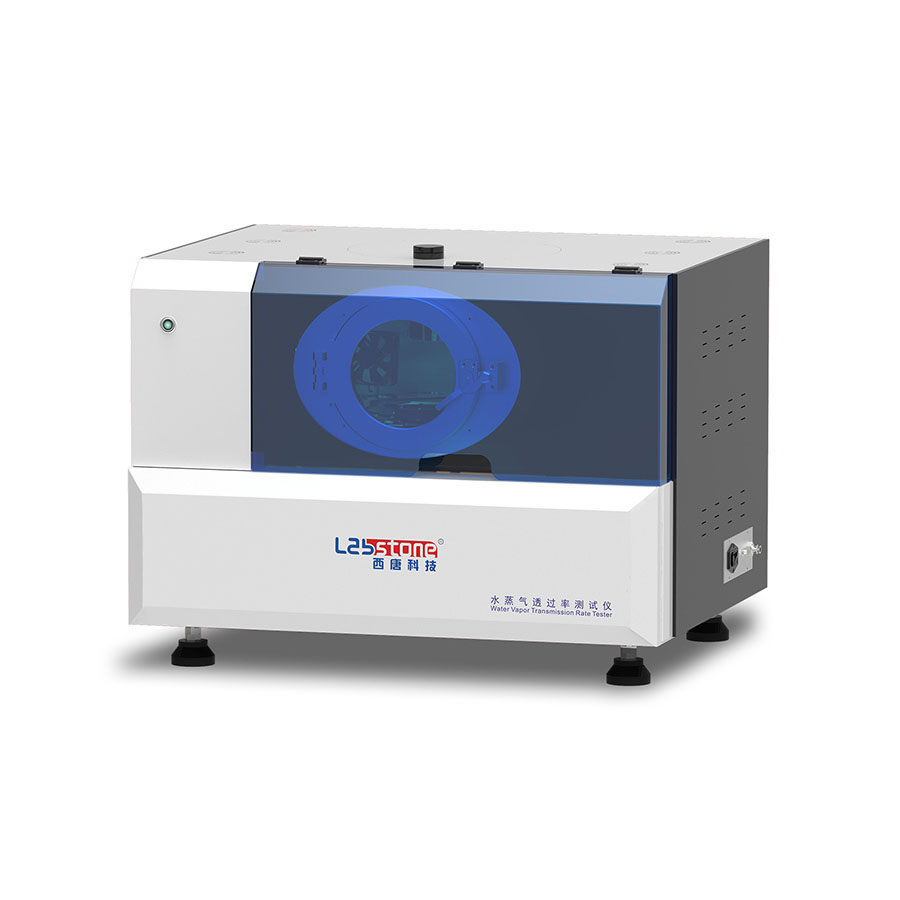
The gravimetric cup method is the “mother method” of WVTR testing: the specimen is sealed over the mouth of a permeability cup containing a desiccant or water, the whole cup sits in a climate-controlled enclosure, and the cup's gain or loss of mass is weighed periodically on a balance; the slope of the mass–time curve gives the transmission rate in g/(m²·24h). All instrument methods (infrared, electrolytic) must be traceable back to it.
Analogy: the loss method is like putting a cup of water in the desert and weighing it daily — watching how fast it thins; the gain method is like putting a cup of desiccant in a sauna — watching how fast it gains. Opposite directions, same question: how much water vapor does this film let through per day.
Definition in the standards
ASTM E96/E96M-24a provides two basic procedures: the Desiccant Method (dry cup), in which a desiccant keeps the inside of the cup nearly dry and the cup gains mass as water vapor enters from outside, and the Water Method (wet cup), in which water inside the cup maintains nearly 100% relative humidity and the cup loses mass as vapor escapes. ISO 2528:2017 specifies the corresponding gravimetric (dish) method for sheet materials.
Choosing between gain and loss
The choice is about vapor-drive direction and gradient size. In the gain method the inside RH is near 0%, so against a 90% RH outside the gradient is maximal — best for high-barrier, slow-transmitting materials, where the gain is small but the direction is stable. The loss method keeps the inside near 100% RH, closer to the real permeation direction when the contents are aqueous (syrups, sauces, solutions) — well suited to mid-to-high transmission materials. Remember the desiccant saturates: replace it or end the test before its uptake capacity is reached; in the water method keep an air gap between the water surface and the specimen so the vapor pressure inside stays stable.
Key operating points
Five things decide data quality: ① conditioning — equalize specimens at the test climate long enough to erase any moisture gradient already in the material; ② edge sealing — wax sealing or flange clamping must force vapor through the face only, side leakage is the largest error source; ③ weighing precision — a 0.1 mg balance, otherwise small gains drown in balance noise; ④ weighing interval — keep cumulative gain/loss inside the balance's good linear range and minimize the time the cup is out of the chamber; ⑤ enclosure air velocity — flow rate changes the boundary layer at the specimen surface and must be fixed per the standard. ASTM E96 Appendix X1 lists common condition sets A–E, and the conditions used must be reported.
Limits and the role of instrument methods
ISO 2528:2017 is explicit: when the transmission rate is expected below 1 g/(m²·24h) or the specimen is thicker than 3 mm, the dish method is no longer suitable — switch to ISO 9932; still lower high-barrier ranges call for instrument methods — the modulated infrared sensor method (ASTM F1249, ISO 15106-2) covering roughly 0.05–50, and the electrolytic detection sensor method (ISO 15106-3, ASTM F3299) with the highest sensitivity. Even so, the gravimetric method remains the basis of arbitration testing and instrument calibration: it weighs mass directly, with no sensor transfer chain in between.
References
- ASTM E96/E96M-24a, Standard Test Methods for Gravimetric Determination of Water Vapor Transmission Rate of Materials, ASTM International, 2024.
- ISO 2528:2017, Sheet materials — Determination of water vapour transmission rate (WVTR) — Gravimetric (dish) method, ISO/TC 6/SC 2.
- ISO 9932, Paper and board — Determination of water vapour transmission rate of sheet materials — Dynamic gas flow and static gas methods, the alternative for low rates and thick specimens.
- ASTM F1249 and ISO 15106-3, the infrared and electrolytic instrument methods.