In the daily work of a quality control laboratory, "loss on drying" and "water content" are two of the most frequently reported physicochemical parameters. Many bench analysts treat them as interchangeable, assuming that whatever the oven drives off must be water. In a regulatory inspection, a CNAS accreditation review or a customer complaint investigation, that assumption can become a critical compliance gap.
Viewed analytically, loss on drying (LOD) and water content may share an oven and a balance, but they do not measure the same thing. Getting this distinction right is essential to writing defensible test reports and preserving data integrity.
1. Definitions: specific versus non-specific
Water content is by definition specific: it quantifies the water molecules (H₂O) in a sample — adsorbed water, absorbed water and part of the water of crystallisation. The recognised gold standard is Karl Fischer titration, which identifies water molecules through a specific chemical reaction and is not disturbed by other volatile substances.
Loss on drying is the broader, non-specific concept. Under Chinese Pharmacopoeia (ChP 2025) general chapter 0831, LOD is "the weight lost when the test sample is dried to constant weight under prescribed conditions". That weight loss includes not only water but every substance able to escape during heating: residual solvents (ethanol, acetone and others), volatile oils, low-molecular-weight polymers, and the decomposition products of thermally unstable components.
The numerical relationship therefore follows: loss on drying ≥ water content. The two values can be treated as approximately equal only when it has been rigorously demonstrated that the sample contains no volatile impurities other than water.
2. Methods: physical weight loss versus chemical quantification
In practice the boundary blurs, precisely because both determinations may use the same oven.
Method A — loss on drying by direct gravimetric determination
This is where automation has advanced furthest. Taking total migration in food-contact materials, or non-volatile residue in purified water, the sequence is typically: weigh precisely → evaporate in a water bath to near dryness → heat in an oven (105 °C, for instance) → cool in a desiccator → weigh precisely → repeat until two consecutive weighings differ by no more than 0.3 mg, the limit set in the pharmacopoeial general notices.
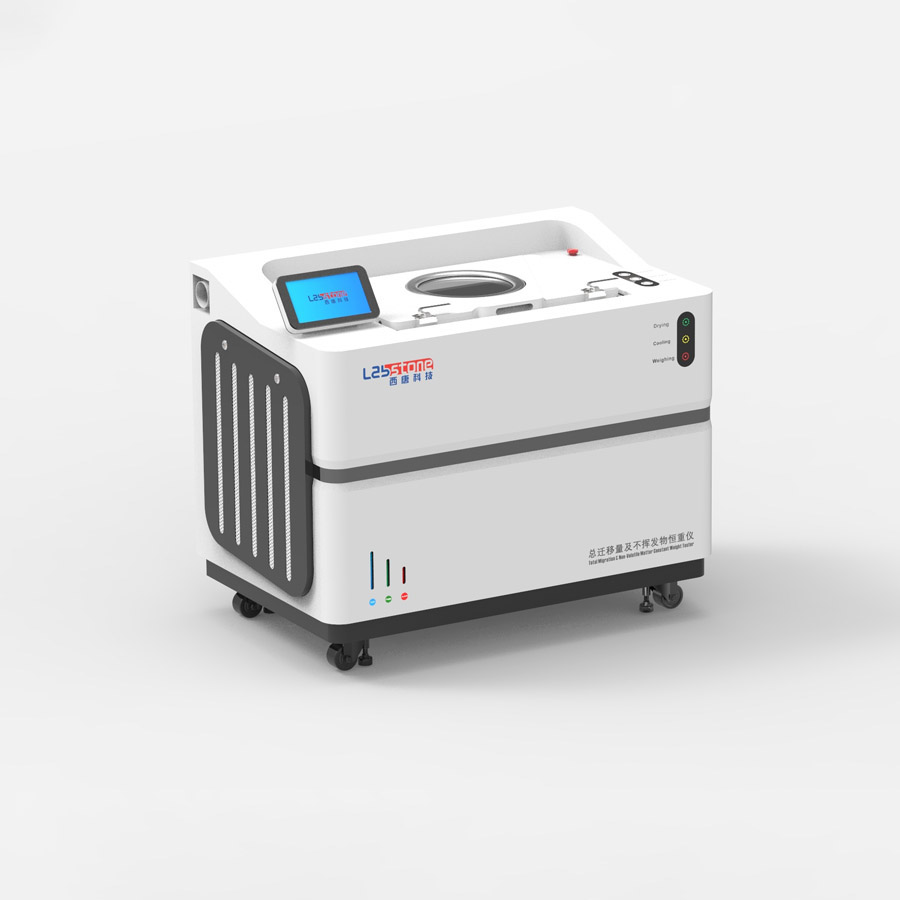
This is a textbook physical weight-loss measurement. Modern automated constant-weight systems integrate water-bath evaporation, temperature-controlled drying, isothermal cooling and automatic weighing — removing the moisture re-uptake, manual error and low throughput of the traditional manual procedure. But however automated the process, what it measures remains total volatiles, not pure water.
Method B — water content by Karl Fischer titration or toluene distillation
To exclude non-aqueous volatiles, the pharmacopoeia provides several water-determination methods (ChP 0832). Karl Fischer titration uses the quantitative reaction of iodine, sulfur dioxide and water to determine water specifically. Toluene distillation separates water by azeotropic distillation with a water-immiscible solvent. Only results from these methods are water content in the strict sense.
3. Compliance: what the standards actually require
The greatest risk in confusing the two lies in compliance. Standards are strict about which method is specified:
- Pharmacopoeias — ChP 0831 (loss on drying) and ChP 0832 (water determination) are two independent general chapters. Where an assay must be calculated "on the dried basis", the LOD value must be used; where it must be calculated "on the anhydrous basis", the Karl Fischer value must be used. The two are never interchangeable.
- Food-contact materials — GB 31604.8-2021, the national food safety standard for determining total migration from food-contact materials and articles, uses water-bath evaporation followed by oven drying and weighing. The result must be reported as "total migration (mg/dm²)" or "evaporation residue" — never abbreviated to "water content".
- Pharmaceutical packaging — the "non-volatile matter" test in the YBB series is likewise a gravimetric residue determination and has nothing to do with water content.
4. Common errors and risk warnings
Several mistakes recur in laboratory management and deserve close attention:
- Concept substitution — entering an evaporation-residue or non-volatile-matter result in the "water content" column. In purified water testing, for instance, reporting a non-volatile matter result of 0.5 mg/L as "water 0.05%".
- Ignoring matrix interference — using oven drying to determine "water" in a sample containing ethanol or another volatile solvent. The ethanol evaporates too and is counted, inflating the result substantially.
- Changing the constant-weight criterion at will — not applying the pharmacopoeial limit of 0.3 mg between two consecutive dryings and relaxing it to 1.0 mg, which places the data outside the legal standard.
5. Conclusion
As detection technology develops, automated systems combining water-bath evaporation, heated drying, cooling, weighing and automatic constant-weight judgement are steadily replacing manual work, greatly improving both throughput and data reliability. But better instrumentation does not replace an understanding of the measurement principle.
For the laboratory professional the point is unambiguous: an automated constant-weight system outputs loss on drying, evaporation residue or non-volatile matter — not absolute water content. Only after rigorous method validation confirming the absence of non-aqueous volatile components may an LOD value be treated as an approximation of water content.
Respecting the boundaries set by standards, and being precise about concepts, is the foundation of scientific, accurate and compliant data. It is a matter of respect for regulatory requirements — and of responsibility for product quality and safety.