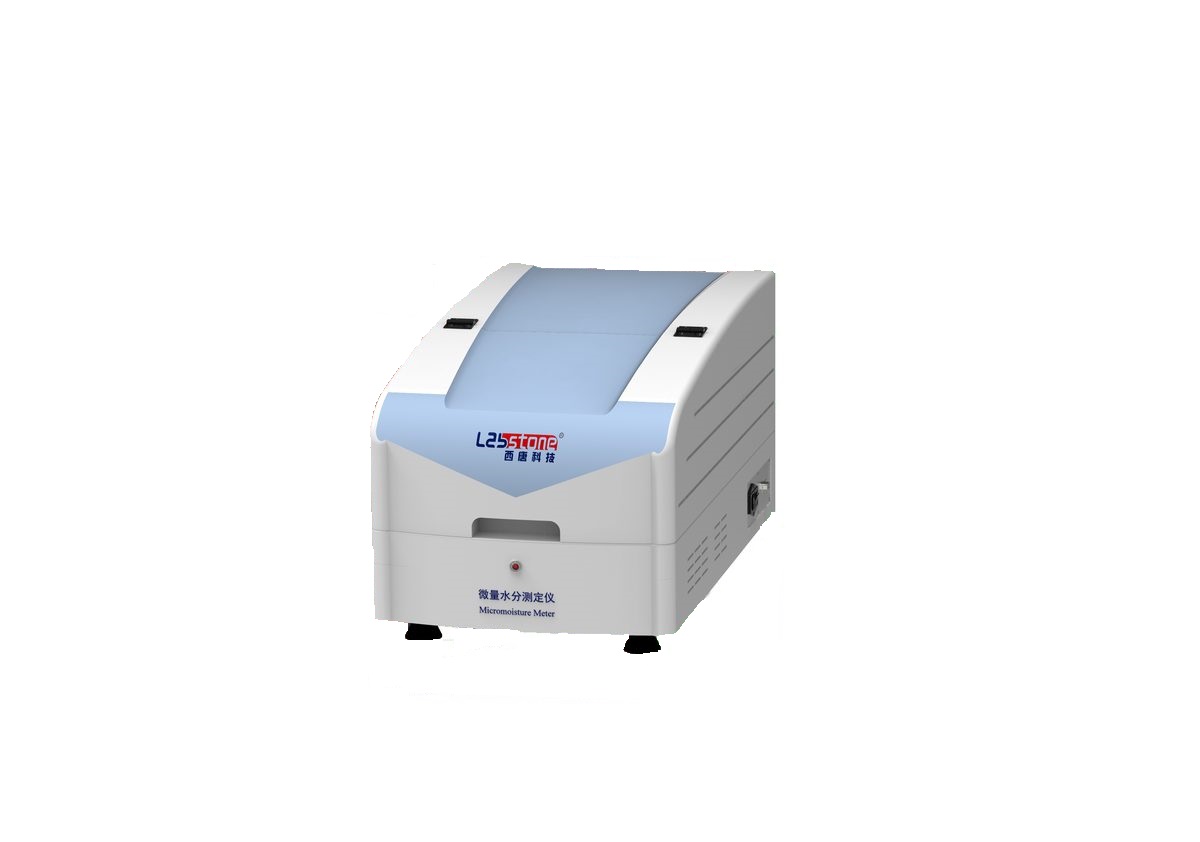
Trace Moisture Tester – Electrolytic Method
Absolute measurement of water content in solid samples (rubber granules, resins, melt-blown nonwovens, desiccants, fibres, sutures) with an electrolytic micro-water sensor, gradient heating from ambient to 300 °C, measurement error 1.22×10⁻³ μg/s.
Purpose | What it does for you
Determines water content in rubber granules, resin raw materials, melt-blown nonwovens, desiccants, fibres, rocks, sutures and other polymer or solid materials. Moisture directly affects processing (bubbles, degradation, silver streaking) and final product quality. Unlike Karl Fischer titration, which needs organic solvents and reagents, this instrument uses dry nitrogen to carry volatilised water to an electrolytic sensor — no chemical reagents, better suited to shop-floor and high-frequency testing.
Key Features
- Electrolytic micro-water sensor with absolute measurement, high accuracy and no chemical reagents
- Parameterised settings, gradient heating, high accuracy and reliability with overload protection
- Fully automatic: no mechanical knobs, one-key start, data saved on power loss
- Error measurement: systematic and sample-loading errors measured, systematic error deducted
- Sample-loading alarm; sensor protection cools and separates volatilised contaminants
- Power-on self-check, graphical full-process monitoring, multi-format reports; optional GMP module
Operating Principle
Electrolysis of water. The sample sits in a sealed constant-temperature chamber; water volatilised from the sample is carried by dry nitrogen (carrier gas) to a micro-water electrolysis sensor. The sensor electrolyses all the water in the carrier gas and the sample's water content is calculated. Gradient and programmed heating are supported, and both systematic and sample-loading errors can be measured with the systematic error deducted for accurate results.
Technical Specifications
| Water Content Range | 0–5% |
|---|---|
| Measurement Error | 1.22×10⁻³ μg/s |
| Sensor Error | 1 ppmv |
| Electrolysis Rate | 3.68 μg/s |
| Sample Capacity | 10–12 mL (customisable) |
| Temperature Range | RT~300 ℃ |
| Temperature Error | ±0.5 ℃ |
| Carrier Gas | 99.999% N₂ |
| Flow Rate | 100 cm³/min |
| Gas Supply Pressure | 0.1–0.2 MPa |
| Interface Size | 1/8 in metal tube |
| Dimensions | 415(L) × 720(W) × 400(H) mm |
| Net Weight | 42 kg |
| Power Supply | AC 220/110 V ±10%,50/60 Hz |
| Power | <1800 W |
Note: Due to continuous product iteration and varying application conditions, the technical parameters on this page are typical reference values and are not to be used as acceptance criteria. For tender and customized projects, the product model, configuration and specifications are subject to the mutually confirmed technical agreement and the actual delivered product. For parameter matching tailored to your specific project, please contact us.
Standard Configuration
Main unit, test computer, professional software, water trap and nitrogen cylinder pressure reducer. User supplies high-purity nitrogen, a funnel and high-temperature gloves.
Application Scenarios
- Incoming moisture inspection of plastic resins and engineering plastic granules
- Moisture control of melt-blown nonwoven (mask material)
- Moisture content evaluation of desiccants, molecular sieves and adsorbents
- Moisture determination of rubber, fibres, sutures and rock samples
Compliance Standards
Industries Served
- Plastics & Rubber
- Material R&D, Universities & Institutes
- Pharmaceutical & Biopharmaceutical
- Medical Devices
- Petrochemical & Energy
- Third-Party & Government Testing Institutes
- Textile & Leather
Frequently Asked Questions
What are the advantages over a Karl Fischer titrator?
No Karl Fischer reagents or organic solvents are needed, so there is no liquid waste, running costs are lower and the work is safer. Dry nitrogen carries the moisture to an electrolytic sensor in an absolute measurement, suited to hard-to-dissolve solids such as polymer granules and nonwovens. If your regulation mandates Karl Fischer, that method governs; this instrument works well as a rapid screening tool.
Does LabStone support OEM/ODM and customised instruments?
Yes. Standard models ship as-is, while chamber count, specimen size, fixtures, temperature range and software modules (including the GMP Computerized System module) can be tailored to your SOP and URS. IQ/OQ/PQ validation documentation packages are available.
What is the typical lead time, and how is shipping handled?
Standard models usually ship in 4–8 weeks; customised builds depend on the agreed scope. Instruments are packed in export wooden cases and can move by sea, air or rail. We supply proforma invoice, packing list and certificate of origin (CO / Form E), and work under EXW, FOB, CIF or DAP terms.
How are installation, training and calibration handled after delivery?
We provide remote installation guidance, bilingual (Chinese/English) manuals and video training; on-site commissioning by our engineers is available. Users can self-calibrate with standard weights, reference films or calibrated leak standards, and third-party calibration certificates can be supplied.
What is the warranty, and how are spare parts supplied?
The instrument carries a 12-month warranty from acceptance plus lifetime maintenance support. Consumables (molecular sieve, desiccant, sealing grease, printer paper) are kept in long-term stock, and key components are international brands available worldwide. We respond to technical enquiries within 24 hours.
Do the instruments comply with ASTM, ISO and pharmacopoeia standards?
Yes. Every instrument lists its applicable standards on the specification page (ASTM, ISO, GB, YBB, Chinese Pharmacopoeia, USP, EP, JIS, DIN, TAPPI and more). The software outputs raw records and reports suitable for audit trails, with an optional GMP / FDA 21 CFR Part 11 compliance module.
Which languages does the software support, and can it integrate with a LIMS?
The software ships with Chinese and English interfaces; other languages can be added on request. Data export is available over RS232, USB, Ethernet or Wi-Fi, and reports can be exported to Excel, PDF or structured files for LIMS integration.