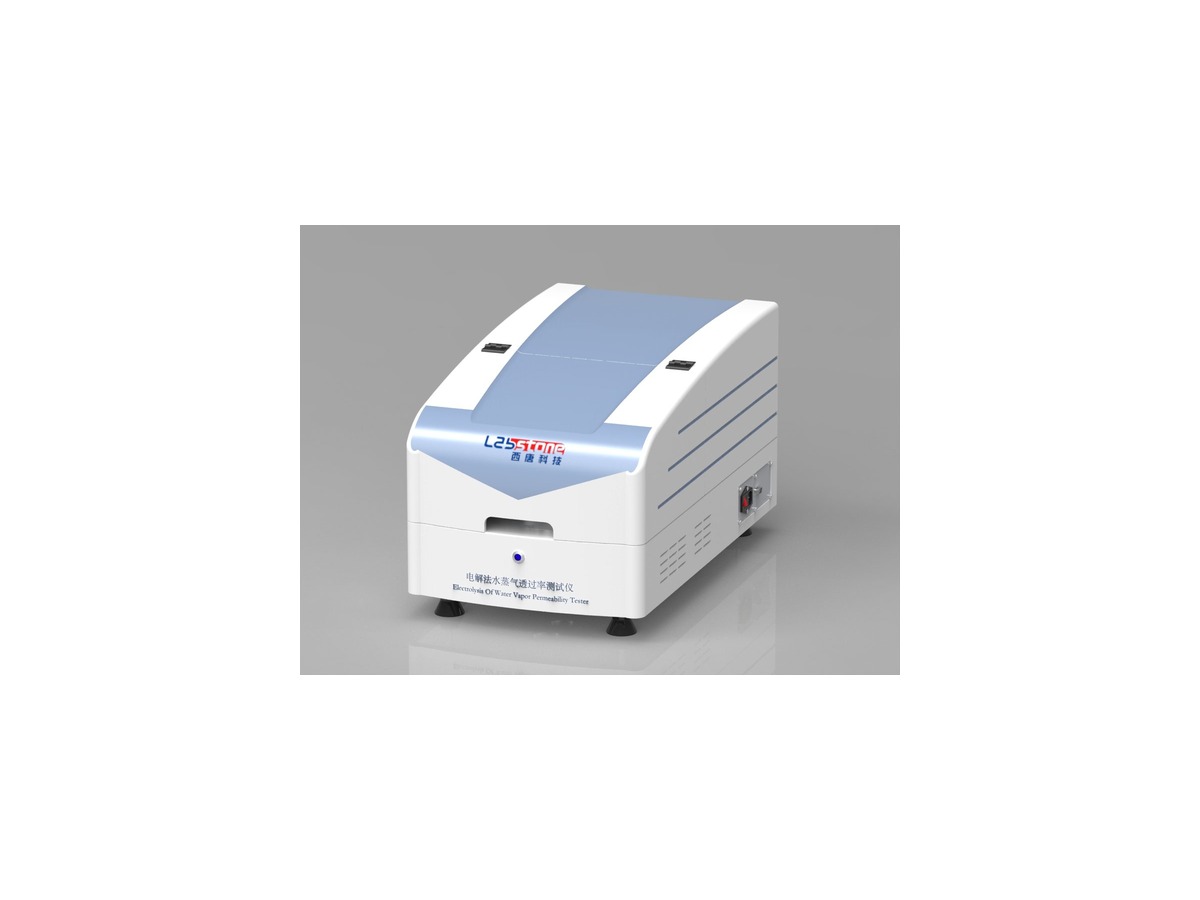
Electrolytic WVTR testing: under specified temperature and humidity, the specimen splits the test cell into a wet side and a dry side; water vapor passing through the specimen is carried by dry carrier gas into an electrolysis cell, where a phosphorus pentoxide (P₂O₅) hygroscopic film absorbs it and electrolyzes it into hydrogen and oxygen. The electrolysis current is directly proportional to the transmission rate and is converted straight into WVTR (in g/(m²·24h)) via Faraday's law.
Analogy: the electrolysis cell is a “water-molecule counter” — every molecule that gets through is captured and counted, and the current reading is the tally. It relies neither on weighing nor on optical detection: water molecules are turned directly into current, which is why this method is the most sensitive of the family.
Definition in the standards
ISO 15106-3, Plastics — Film and sheeting — Determination of water vapour transmission rate — Part 3: Electrolytic detection sensor method, specifies the determination of WVTR using a continuously operating electrolytic detection sensor: water vapor passing through the specimen is carried by the carrier gas to the electrolysis cell and electrolyzed on a phosphorus-pentoxide-containing membrane, the electrolysis current being proportional to the transmission rate. ASTM F3299 is the corresponding US standard (coulometric P₂O₅ sensor).
How the electrolysis cell works
The cell has a P₂O₅ coating between two platinum electrodes. Before testing, dry carrier gas purges the system until the background current is stable; water vapor then entering with the carrier gas through the specimen is fully absorbed by the P₂O₅ and electrolyzed across the electrodes. By Faraday's law, electrolyzing one mole of water (18 g) requires about 96485 coulombs, so the current maps directly to the transmission rate — quantitative without any reference-film calibration, which is the key difference from the infrared method (which requires calibration).
Where it fits and typical ranges
The standout advantage is sensitivity: commercial instruments reach detection limits on the order of 0.001 g/(m²·24h), with a typical working range of about 0.001–100 g/(m²·24h). It targets high-barrier materials: pharmaceutical blister foil, metallized film, PVDC/EVOH high-barrier laminates, solar backsheets and OLED encapsulation films. For high-transmission materials (paper, nonwovens), the permeate load would overwhelm the cell — use the gravimetric cup method instead.
Comparison with gravimetric and infrared methods
Each route has its role: the gravimetric cup method (ASTM E96, ISO 2528) is the reference method, covering roughly 1–1000 g/(m²·24h) but taking days; the modulated infrared sensor method (ASTM F1249, ISO 15106-2) covers roughly 0.05–50 with single tests under 2 hours, ideal for routine QC; the electrolytic method (ISO 15106-3, ASTM F3299) is the most sensitive and needs no calibration film, fitting ultra-high-barrier and shelf-life studies, at the cost of a consumable cell that needs maintenance or recoating. The ISO 15106 series extends further: pressure sensor method (Part 5), ionization mass spectrometry (Part 6), calcium corrosion method (Part 7).
References
- ISO 15106-3:2003, Plastics — Film and sheeting — Determination of water vapour transmission rate — Part 3: Electrolytic detection sensor method, ISO.
- ASTM F3299, Standard Test Method for Water Vapor Transmission Rate of Plastic Film and Sheeting Using an Electrolytic Detection Sensor, ASTM International.
- ISO 15106-2 (infrared detection sensor method) and ASTM F1249 (modulated infrared sensor method), the mid-range instrument methods.