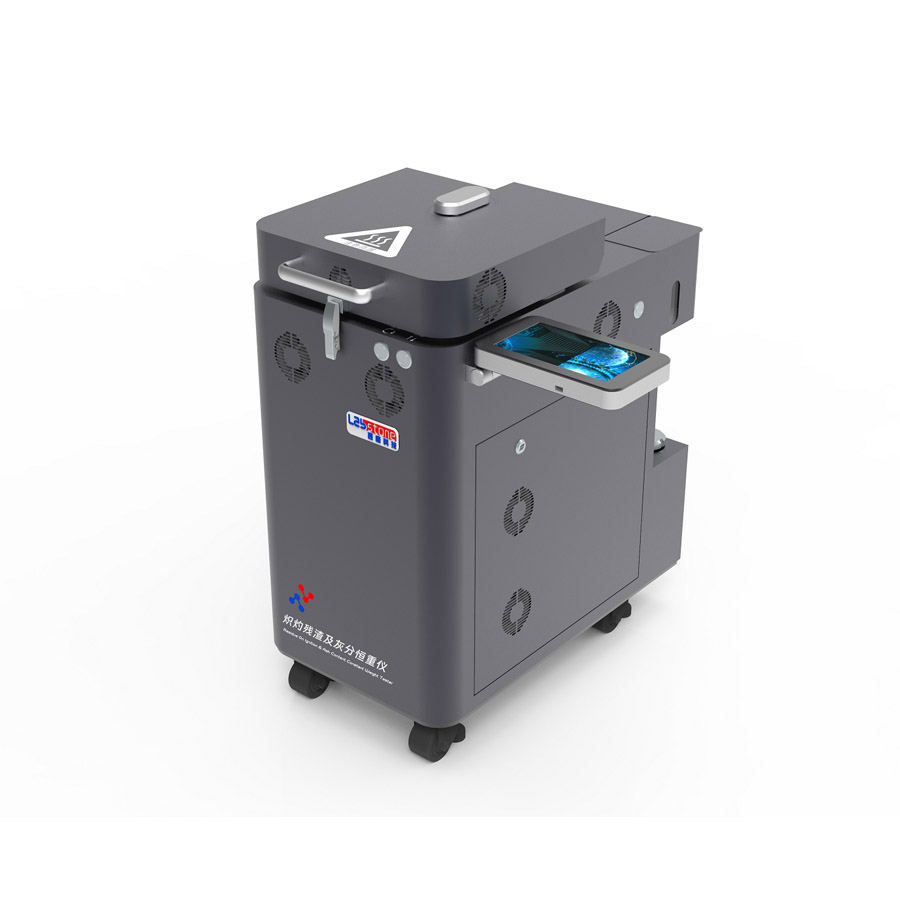
Ash determination standards — the Chinese Pharmacopoeia, GB 5009.4 and others — all require the sample to be dried, ignited, cooled and weighed repeatedly until “two consecutive weighings differ by no more than the specified limit”. This process is called constant weight. Why can't ash be determined with a single weighing? What is the science behind constant weight?
The scientific meaning of constant weight
Confirmation that the reaction is complete. The mass change of a sample at high temperature is a dynamic process. A first weighing only reflects the state at one instant; because organic matter may not yet be fully decomposed, or the carbonates formed may not yet have fully converted to oxides, a single weighing cannot confirm that the sample has reached its most stable ash state.
Removing environmental and operational variables. Ambient humidity, temperature drift and the random error of the balance all affect a single weighing. By weighing twice or more and comparing the difference, these accidental errors can be identified and filtered out, preserving the trueness and repeatability of the data.
The challenge of manual constant weight
In practice, constant weight is usually the most time-consuming step. The operator must shuttle repeatedly between the muffle furnace, the desiccator and the balance; if two results exceed the limit, the sample has to go back into the furnace. Long operations are not only inefficient — they invite mistakes through fatigue.
How automation executes the constant-weight logic
An integrated automatic constant-weight system turns the constant-weight requirement into machine-executed logic, markedly raising scientific rigour.
Fully automatic cyclic testing. Software embeds the constant-weight algorithm required by the pharmacopoeia and national standards, and the instrument automatically runs the heat–hold–cool–weigh cycle; if the criterion is not met, it returns the sample to the high-temperature zone until the condition is satisfied.
High-precision stability judgement. With a 0.1 mg balance division and a 0.3 mg constant-weight discrimination accuracy, the system captures extremely small mass changes and monitors around the clock, so the endpoint is true constant weight rather than a human compromise of “almost constant”.
Compliant, traceable data. Every weighing's value, time and temperature are recorded in real time and plotted as multi-dimensional curves. The constant-weight conclusion is no longer just a final number but a complete, traceable chain of process data that satisfies laboratory audit and compliance requirements.
Conclusion
Constant weight is the cornerstone of credible ash data. Reproducing and strictly enforcing the scientific definition of constant weight through automation leaves every result beyond dispute.