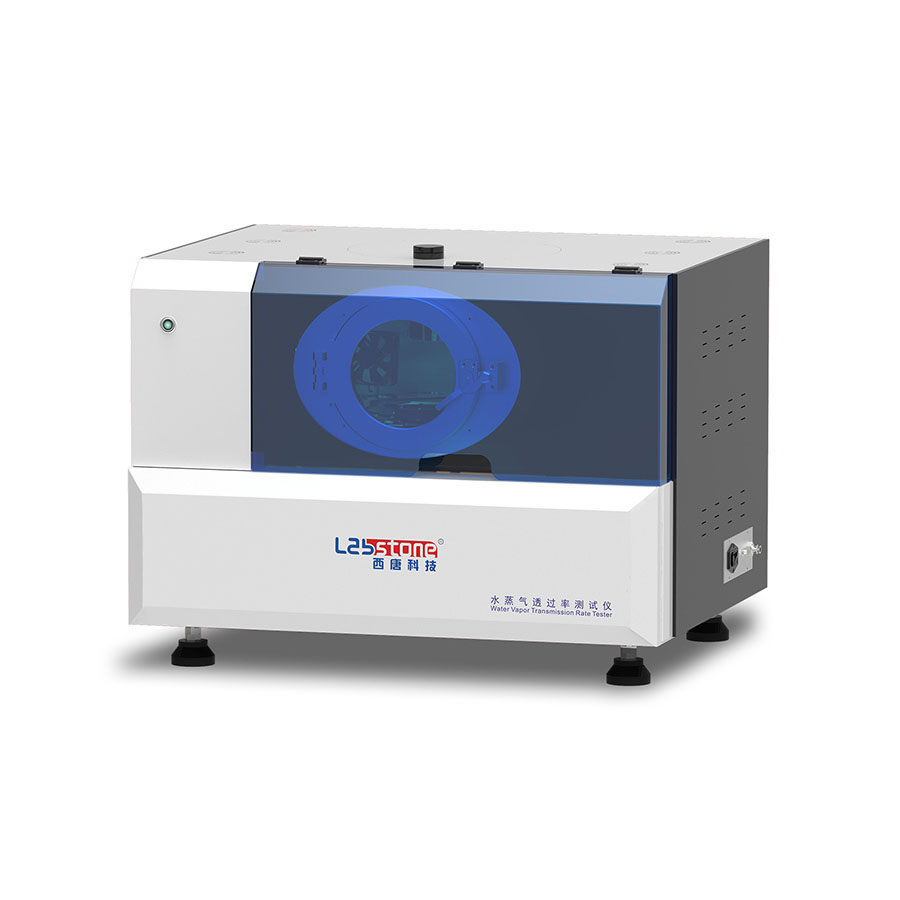
Water Vapor Transmission Rate (WVTR) is the mass of water vapor allowed to pass through one square meter of packaging material per day under specified temperature and humidity conditions, commonly expressed in g/(m²·24h). The lower the value, the stronger the moisture-barrier performance of the material.
Analogy: think of a packaging film as a raincoat, and water vapor as the moisture that keeps trying to sneak in. WVTR is the total amount of moisture that gets through each day. The tighter the raincoat (high-barrier material), the less gets in — and the slower biscuits and tablets inside absorb moisture, the longer the shelf life.
Definition in the standards
ASTM E96/E96M-24a, Standard Test Methods for Gravimetric Determination of Water Vapor Transmission Rate of Materials, defines water vapor transmission as “the steady water vapor flow in unit time through unit area of a body, normal to specific parallel surfaces, under specific conditions of temperature and humidity at each surface.” The standard provides two basic procedures: the Desiccant Method (dry cup) and the Water Method (wet cup). ISO 2528:2017 specifies the gravimetric (dish) method for sheet materials and notes that WVTR is “often erroneously called permeability.”
One measurement, several names
WVTR also appears as WVT, moisture vapor transmission rate, moisture permeability and similar names in different contexts — a common source of confusion. ASTM E96 distinguishes three terms: WVTR, the transmission rate in g/(m²·24h); water vapor permeance, the transmission rate per unit area and per unit vapor pressure difference, in g/(Pa·s·m²) (the construction field commonly uses the perm); and water vapor permeability, permeance divided by thickness, which is meaningful only for homogeneous materials. ISO 2528:2017 explicitly warns in its abstract that calling WVTR “permeability” is a common error — the term permeability applies only when the value is converted into an intrinsic material property.
Test methods and typical ranges
The classical method is the gravimetric cup method (ASTM E96, ISO 2528): a dish sealed with the specimen contains a desiccant or water, and the cup is weighed periodically to track gain or loss. ISO 2528:2017 recommends switching to the method of ISO 9932 when the transmission rate is expected to be below 1 g/(m²·24h) or the material is thicker than 3 mm. Lower, high-barrier ranges call for instrument methods: the modulated infrared sensor method (ASTM F1249, ISO 15106-2) and the electrolytic detection sensor method (ISO 15106-3). Typical ranges: high-barrier foil laminates are commonly specified below 0.5 g/(m²·24h); PVDC- or EVOH-based high-barrier laminates fall around 0.1–5; single-layer PE or PP films range from a few to tens of g/(m²·24h).
Relation to OTR and GTR
The three belong to the same packaging-barrier family: WVTR measures water vapor, GTR measures various gases by the differential-pressure method, and OTR measures oxygen only. Most pharmaceutical and food packaging product standards specify two or more of them, so quality-control laboratories typically operate both moisture-vapor and oxygen/gas permeation instruments.
References
- ASTM E96/E96M-24a, Standard Test Methods for Gravimetric Determination of Water Vapor Transmission Rate of Materials, ASTM International, 2024.
- ISO 2528:2017, Sheet materials — Determination of water vapour transmission rate (WVTR) — Gravimetric (dish) method, ISO/TC 6/SC 2.
- ASTM F1249, Standard Test Method for Water Vapor Transmission Rate Through Plastic Film and Sheeting Using a Modulated Infrared Sensor, ASTM International.
- ISO 15106-2 (infrared detection sensor method) and ISO 15106-3 (electrolytic detection sensor method), ISO.