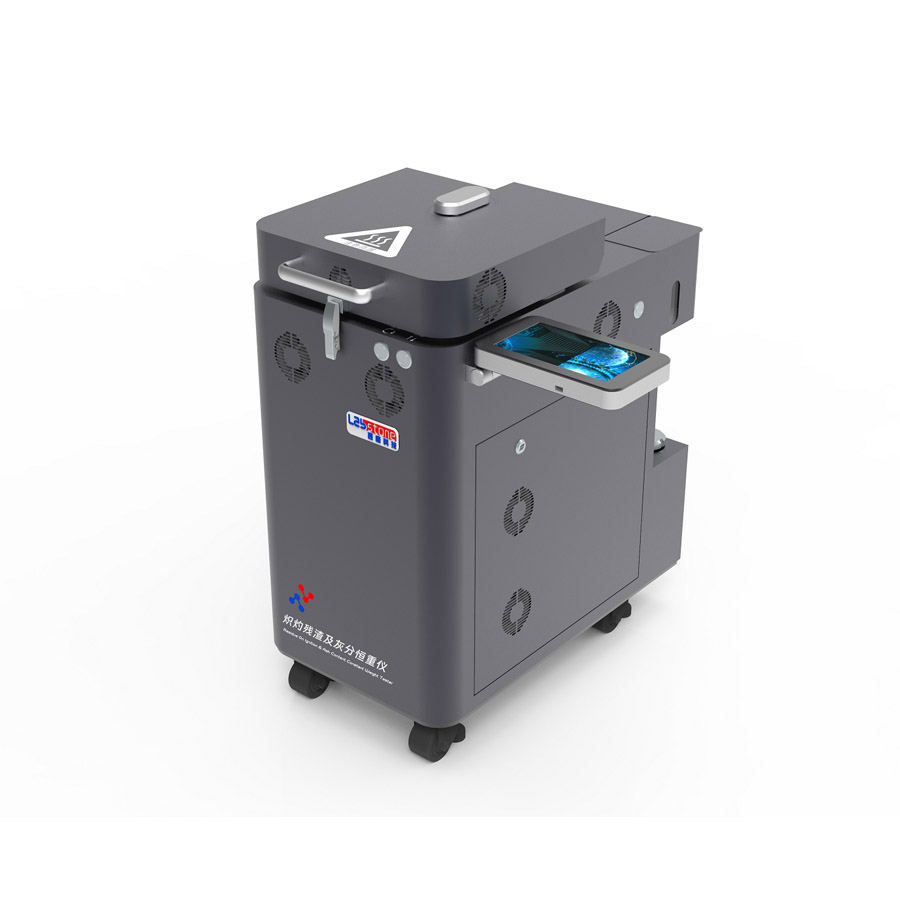
In solid-waste treatment, refuse incineration and environmental monitoring, loss on ignition (LOI) is the key indicator of whether combustion is complete and how effectively organic material has been removed. Under standards such as HJ 1024, LOI determination likewise requires strict constant-weight control. But because solid-waste samples are unusual, reaching constant weight here is harder than in routine ash determination.
Why LOI is different
High calorific value, violent reaction. Municipal and industrial solid waste typically contains a large combustible organic fraction, so the mass changes rapidly during heating. With poor temperature control, the sample may suffer physical loss — fly ash carried off by the gas stream — before the constant-weight criterion is ever met, and the data becomes meaningless.
Widely varying hygroscopicity. Ash from different waste streams differs enormously in specific surface area and chemical composition, and therefore in how it takes up moisture. Some fly ash can absorb a significant amount of water within minutes of air exposure, which makes the constant-weight decision very difficult.
Demanding temperature regime. LOI testing generally calls for a hold at 600 °C or 800 °C with very high temperature uniformity, so that all samples in a batch behave alike.
Three levers for constant-weight control
A stable atmosphere. To counter moisture uptake in waste ash, a fully sealed internal circulation design is used. During cooling and weighing the system maintains an inert or dry-air environment, removing the effect of ambient humidity swings on the constant-weight decision — whatever the weather outside, the internal low-humidity baseline stays constant.
Wide-range temperature control and uniformity. Room temperature to 1000 °C is supported, with an adjustable ramp (0–50 °C/min). For LOI, the target of 600 °C or 800 °C can be set precisely, with ±2 °C control accuracy, so that samples across all stations see the same thermal history and replicate results do not drift apart through temperature differences.
Automated endpoint determination. Judging by eye whether a waste sample has reached constant weight is inherently subjective. Software monitors the mass–time curve in real time and records the result only when the rate of mass change falls strictly below the standard threshold — 0.1 %/min, or an absolute difference under 0.5 mg — and then computes the LOI value. This data-driven approach is considerably more objective than a human call.
Multi-station parallel processing. Solid-waste laboratories handle large batches; 12 / 16 / 19 / 32 station capacity completes dozens of parallel samples in a single run, so every sample goes through the constant-weight sequence under identical conditions and the results are properly comparable.
Conclusion
Constant-weight control in LOI testing bears directly on how scientifically incineration performance is assessed. Automation, sealed operation and data-driven endpoint judgement together overcome the twin difficulties of waste samples — hard to control, quick to absorb moisture — and give environmental monitoring a firmer data base.