Many environmental monitoring laboratories notice the same thing when they take on total-salt determination in water: the time is not spent evaporating the water — it is spent reaching constant weight afterwards.
HJ 51-2024, Water quality — Determination of total salt — Gravimetric method, has been in force since 1 July 2025, replacing HJ/T 51-1999. It applies to surface water, groundwater, domestic sewage and industrial wastewater.
The standard is gravimetric: the residue must be dried at 105 °C ± 2 °C to constant weight, and constant weight is reached only when two consecutive drying-and-weighing results differ by no more than 0.5 mg.
In practice a single determination can therefore involve several rounds: dry → cool → weigh → judge → dry again.
Step one: the empty dish must reach constant weight too
This is easily overlooked. HJ 51-2024 does not weigh the residue directly; total salt is obtained from the combined mass of residue plus dish, minus the mass of the empty dish.
The dish must therefore be dried, cooled and weighed, with the sequence repeated until constant weight is reached. The standard requires at least 1 h per drying cycle, followed by repeated drying, cooling and weighing until constant weight. In other words, constant weight of the empty dish is itself a full experimental step.
Step two: the sample must reach constant weight again
Only once the empty dish is at constant weight can the sample be added. Under HJ 51-2024, typically 100 mL of water sample is filtered through a 0.45 μm membrane, added to the dish already at constant weight, and evaporated in a water bath.
Once dry, residual organic matter is removed with hydrogen peroxide, and the dish then goes through 105 °C ± 2 °C drying, cooling and weighing again until constant weight is reached.
The whole sequence is therefore: empty-dish constant weight → sample evaporation → residue treatment → sample constant weight → result calculation. That is why the manual workload of the gravimetric total-salt method is far from trivial.
Where is manual constant weight hardest?
Take a laboratory running 30 water samples in one batch. If every dish needs several weighings, the operator must repeatedly:
- open the oven;
- take out the dish;
- cool it;
- carry it to the balance;
- weigh it;
- record the data;
- decide whether constant weight has been reached;
- put it back in the oven.
And that is only the sample. The empty-dish constant weight has to be completed first. As batch size grows, constant weight quickly becomes the bottleneck of the whole workflow.
How does an automated evaporation constant-weight system help?
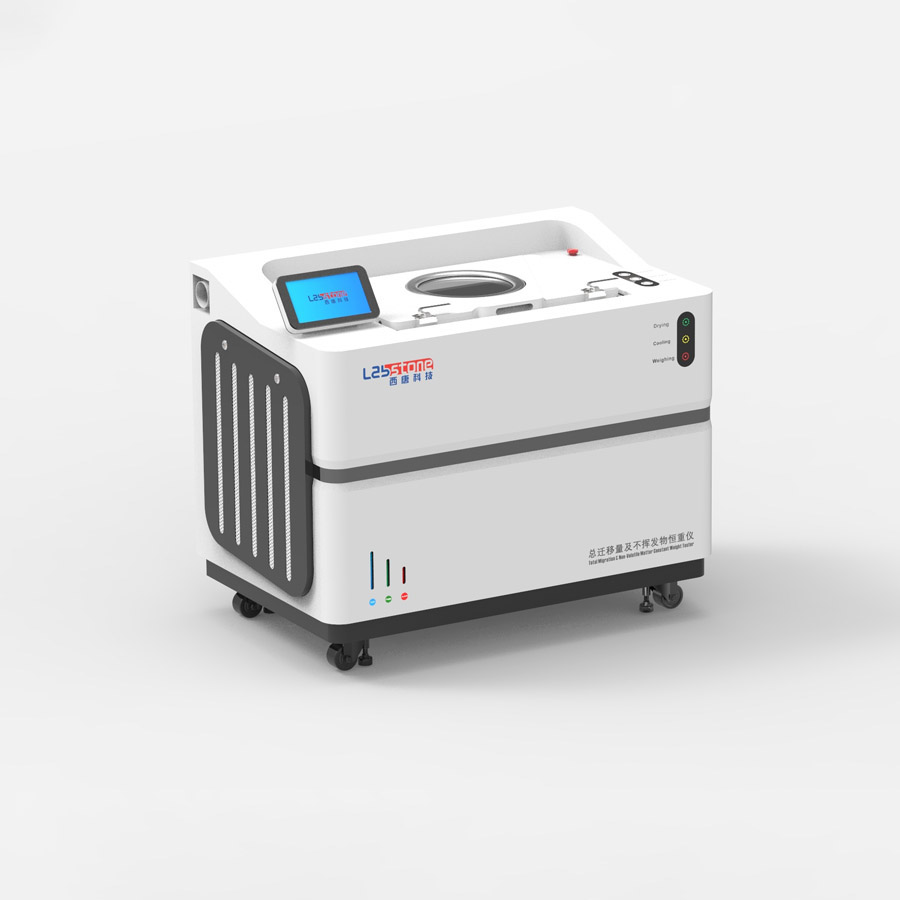
An automated evaporation constant-weight system built for this workflow integrates water-bath evaporation + heated drying + automatic cooling + precision weighing + constant-weight judgement into a single instrument.
The system can complete empty-dish constant weight first, then sample evaporation and residue constant weight. When consecutive weighing results meet the configured constant-weight condition, it ends that sample's sequence automatically.
One point deserves emphasis: the instrument's constant-weight error must be narrower than the threshold the standard sets — otherwise automation itself becomes a source of error. Designed to a 0.3 mg constant-weight error, a system leaves margin against the 0.5 mg criterion in HJ 51-2024. The laboratory must still complete every filtration, hydrogen peroxide and drying step, and every other pre-treatment and quality-control requirement.
Managing samples in batches
For a laboratory running water quality in batches, the number of samples a single instrument can manage at once sets the daily throughput directly. Some models handle up to 69 samples at a time.
The instrument is not simply replacing an analytical balance — it consolidates operations that were previously scattered across a water bath + drying oven + desiccator + analytical balance + manual records.
What automated constant weight really delivers
The value is not simply letting the instrument weigh for the operator. It addresses a long-standing pain point in gravimetric testing:
- a large number of repeated weighings;
- frequent manual handling;
- repeated constant-weight judgement;
- difficulty managing samples in batches.
For a laboratory running only a few samples a day the benefit may be limited. For one processing dozens or more, automated constant weight removes a substantial amount of repetitive work.
Conclusion
HJ 51-2024's total-salt method is a textbook evaporation – drying – constant weight – weighing determination.
A laboratory wanting to raise throughput should therefore look beyond evaporation speed and focus on the two repetitive stages: empty-dish constant weight and sample constant weight.