HJ 51-2024, Water quality — Determination of total salt — Gravimetric method, came into force on 1 July 2025, replacing HJ/T 51-1999.
It applies to the determination of total salt in surface water, groundwater, domestic sewage and industrial wastewater, giving environmental monitoring laboratories an updated methodological basis for the gravimetric total-salt test.
For any laboratory working gravimetrically, HJ 51-2024 contains one step that deserves close attention: constant weight.
What is total salt?
Under HJ 51-2024, total salt is the mass of residue obtained by filtering the sample through a 0.45 μm membrane, evaporating the filtrate to dryness, removing organic matter with hydrogen peroxide, and drying at 105 °C ± 2 °C to constant weight.
The determination is not a single weighing after evaporating the water. It runs through filtration, evaporation, removal of organic matter, drying and constant weight, and only then is total salt calculated from the change in mass of dish plus residue.
The basic procedure in HJ 51-2024
In outline, the standard method runs: sample filtration → dish to constant weight → water-bath evaporation → hydrogen peroxide treatment → drying at 105 °C ± 2 °C → cooling → weighing → further drying and weighing → constant weight reached → result calculated.
The standard requires the evaporation dish to be brought to constant weight first: dried at 105 °C ± 2 °C with at least 1 h per cycle, cooled, weighed and the sequence repeated until constant weight. The mean of the last two weighings is then taken as the mass of the dish at constant weight.
Only then is typically 100 mL of sample taken and determined. After water-bath evaporation, residual organic matter is removed with hydrogen peroxide and the same drying, cooling and weighing sequence is applied to bring the sample to constant weight.
Why must the empty dish be brought to constant weight first?
This is a critical step in gravimetric work. The result is not simply the mass of the residue but: mass of dish plus residue at constant weight, minus mass of dish at constant weight.
If the empty dish's own mass has not stabilised, the subsequent calculation of residue mass has no dependable baseline. HJ 51-2024 therefore contains two constant-weight procedures: step one, constant weight of the empty dish; step two, constant weight of the residue after evaporation. Only when both are complete is the residue mass reliable.
What does HJ 51-2024 require of constant weight?
The new standard defines constant weight as: the difference between two consecutive drying-and-weighing results is no greater than 0.5 mg.
That rules out a single dry-and-weigh. If two results still differ by more than 0.5 mg, drying, cooling and weighing continue until the criterion is met. This is also the most labour-intensive part of the gravimetric total-salt determination.
What does automated constant-weight technology solve?
For environmental laboratories running total-salt determinations in batches, the constant-weight stage involves a great deal of repetition. Operators move continuously between oven, desiccator and analytical balance: take the dish → cool → weigh → record → judge → dry again. With dozens of samples in one batch, that repetition multiplies quickly.
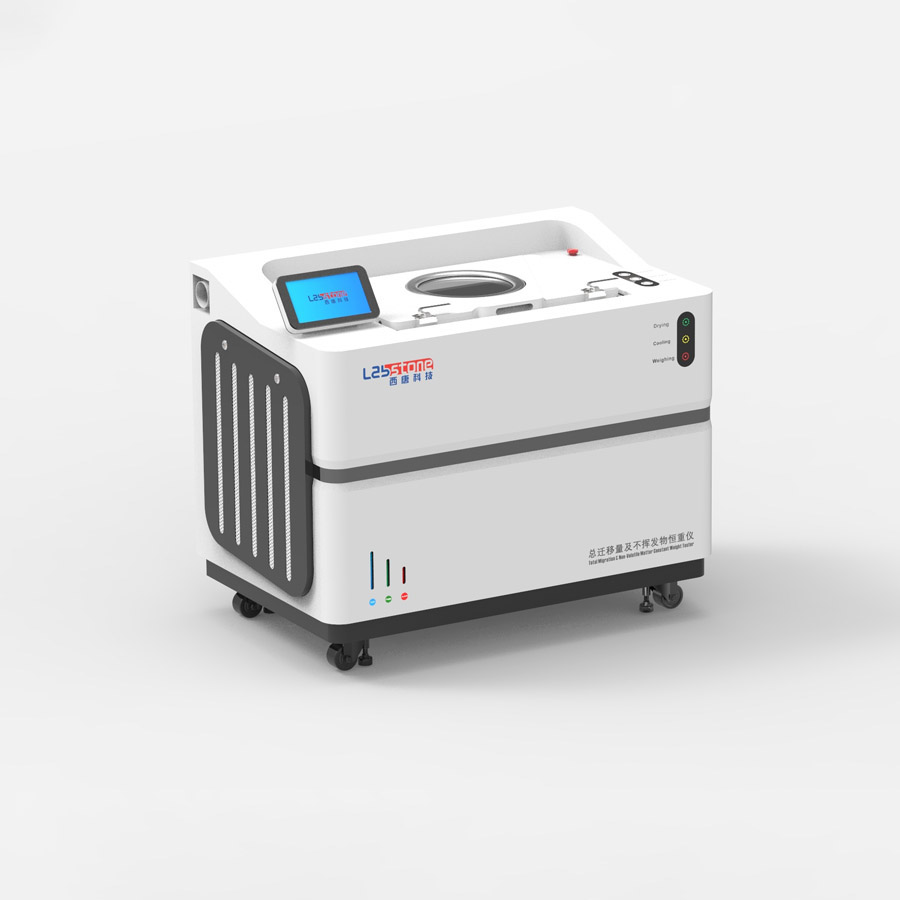
An automated evaporation constant-weight system designed for post-evaporation constant-weight work integrates water-bath evaporation, heated drying, cooling, precision weighing and constant-weight judgement in a single instrument.
Its constant-weight error is specified at 0.3 mg, against the 0.5 mg criterion in HJ 51-2024. At instrument level, its constant-weight capability covers what the standard requires for the constant-weight decision.
How does one instrument map onto the HJ 51-2024 procedure?
In practice the workflow can be understood as:
- Empty-dish constant weight — the instrument dries, cools and weighs automatically, continuously comparing results until the dish is at constant weight;
- Sample addition — the water sample, filtered through a 0.45 μm membrane, is added to the dish already at constant weight;
- Water-bath evaporation — the instrument evaporates the water from the sample;
- Residue treatment and drying — after hydrogen peroxide treatment as HJ 51-2024 requires, the residue is dried at 105 °C ± 2 °C;
- Automatic cooling and weighing — precision weighing follows cooling, automatically;
- Automatic constant-weight decision — once two consecutive weighings meet the configured condition, the system ends the sequence and records the final data.
The instrument does not change the principle of HJ 51-2024 — it automates a large part of its repetitive constant-weight work.
Which environmental laboratories is it for?
HJ 51-2024 covers surface water, groundwater, domestic sewage and industrial wastewater, so the laboratories applying this gravimetric method include ecological and environmental monitoring bodies, third-party environmental testing organisations, water-quality laboratories, and related research and industrial laboratories. For laboratories with substantial sample volumes, the value of automated constant weight is particularly clear.
Automated evaporation constant-weight systems are available with 23, 33, 46 and 69 test stations, supporting up to 69 samples in a batch — for gravimetric determinations that require evaporation, drying and constant weight.
Conclusion
HJ 51-2024 gives water-quality total-salt determination a new standards basis. Besides filtration, evaporation and hydrogen peroxide treatment, laboratories should focus on constant weight of the empty dish and of the sample.
For laboratories with large sample volumes, moving constant weight from repeated manual operations to automated operation reduces weighing, recording and constant-weight judging work and improves batch throughput.