In gravimetric total-salt testing of water quality, constant weight is a pivotal concept.
HJ 51-2024, Water quality — Determination of total salt — Gravimetric method, has replaced HJ/T 51-1999 and has been in force since 1 July 2025. The new standard applies to total-salt determination in surface water, groundwater, domestic sewage and industrial wastewater.
So what exactly does constant weight mean in HJ 51-2024? Why 0.5 mg? And how can a laboratory improve the efficiency of the constant-weight step?
How does HJ 51-2024 define constant weight?
The standard states: constant weight may be considered reached when the difference between two consecutive drying-and-weighing results is no greater than 0.5 mg.
Two expressions carry the meaning: two consecutive weighings, and 0.5 mg.
Constant weight is therefore not one weighing — it requires at least two results to be compared. For example: first weighing 52.6312 g, second weighing 52.6310 g. The difference is 0.2 mg, below 0.5 mg, so the constant-weight criterion is met.
If the difference still exceeds 0.5 mg, drying, cooling and weighing continue.
Why consecutive weighings?
The residue left after evaporating a water sample may contain various inorganic salts and small amounts of other material. Held at 105 °C ± 2 °C, the sample mass may still be changing.
With a single weighing there is no way to answer the only question that matters: has this mass actually stabilised? Only a comparison of two consecutive weighings can show whether the mass is essentially stable. That is the purpose of constant weight.
Why is HJ 51-2024 especially prone to weighing error?
The standard notes specifically that calcium and magnesium chlorides readily absorb water, and that the water of crystallisation in some sulfates is difficult to remove — either effect can push results high. It also suggests adding a defined amount of anhydrous sodium carbonate, reducing the sample volume, and weighing quickly, to suppress the interference.
Operators must therefore watch not only the drying step but also the cooling conditions, the weighing speed and the weighing environment. These are exactly the problems an automated constant-weight instrument has to solve.
How does automation reduce human error?
In a conventional laboratory the operator performs the whole loop manually: dry → cool → weigh → record → compare → dry again. Every sample repeats it.
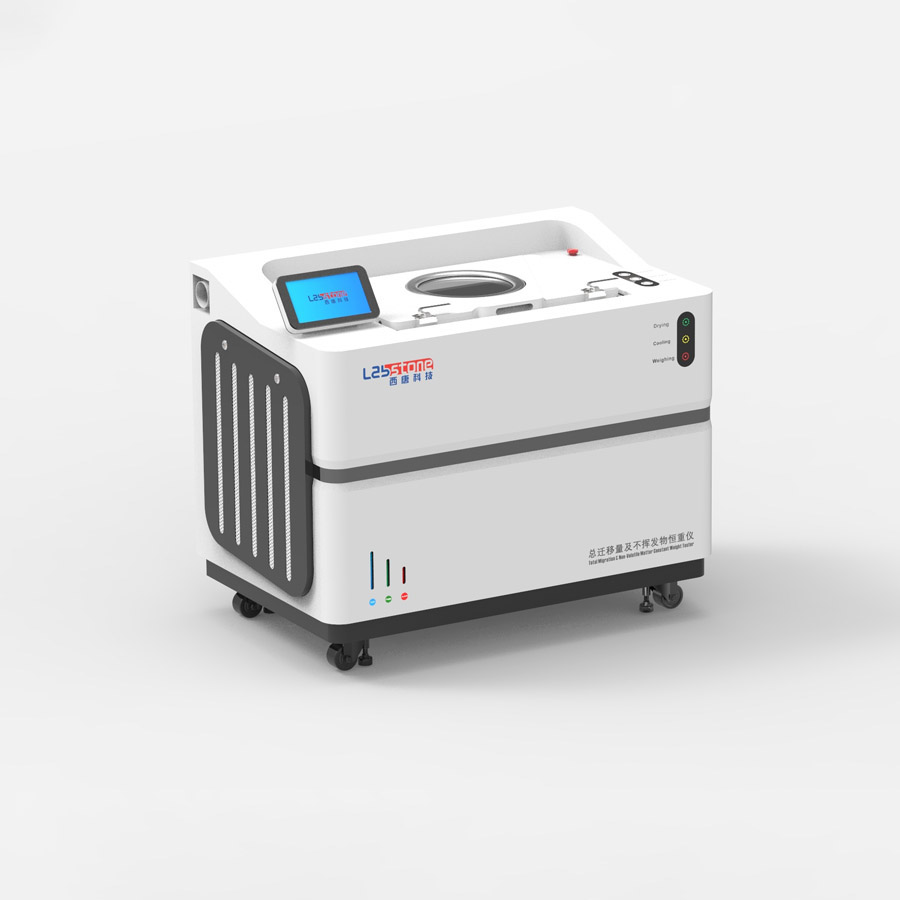
An automated evaporation constant-weight system performs drying, cooling, precision weighing and constant-weight judgement automatically, and records the weighing data. Its constant-weight error is specified at 0.3 mg.
At instrument level that is narrower than the 0.5 mg criterion in HJ 51-2024. Even so, when such an instrument is used for an actual determination, the laboratory must still carry out filtration, hydrogen peroxide treatment, drying at 105 °C ± 2 °C and all other pre-treatment and quality-control requirements the standard lays down.
Both empty-dish and sample constant weight can be managed automatically
HJ 51-2024 does not involve a single constant-weight step. Stage one is constant weight of the empty evaporation dish; stage two is constant weight of the sample residue.
The standard requires the empty dish to be repeatedly dried, cooled and weighed at 105 °C ± 2 °C until constant weight, and only then is the water sample added. What suits automation, therefore, is not an isolated weighing action but the whole constant-weight workflow.
From manual to automated constant weight
Conventional mode: operator fetches dish → dry → cool → weigh → record → judge → dry again.
Automated mode: system dries → cools automatically → weighs automatically → compares automatically → decides automatically.
For small batches the difference may be hard to see. For a laboratory running dozens of samples a day it is unmistakable.
Automated evaporation constant-weight systems are available in 23, 33, 46 and 69-station models, managing up to 69 samples in a batch — suitable for determinations that require evaporation, drying and constant weight.
Faster is not automatically better
Automation does not mean simply shortening the drying time the standard prescribes. HJ 51-2024 requires each drying cycle to last at least 1 h and constant weight to be reached before the step ends.
The right kind of automation therefore: completes the treatment the standard requires → performs the repeated drying and weighing automatically → ends automatically once constant weight is reached.
In other words, the point of automation is to remove repetitive manual work, not to alter the conditions the standard specifies.
Conclusion
For gravimetric total-salt determination under HJ 51-2024, constant weight is the step that decides how reliable the final weighing is. Because the standard requires two consecutive results within 0.5 mg, the operator must dry, cool and weigh repeatedly.
Automated systems perform drying, cooling, precision weighing and constant-weight judgement without manual intervention. With a constant-weight error specified at 0.3 mg, they provide automatic constant-weight support for laboratories working to HJ 51-2024.
For environmental monitoring and third-party testing laboratories with substantial sample volumes, the benefit is not only fewer weighings but a more standardised, digitised and efficient gravimetric workflow overall.