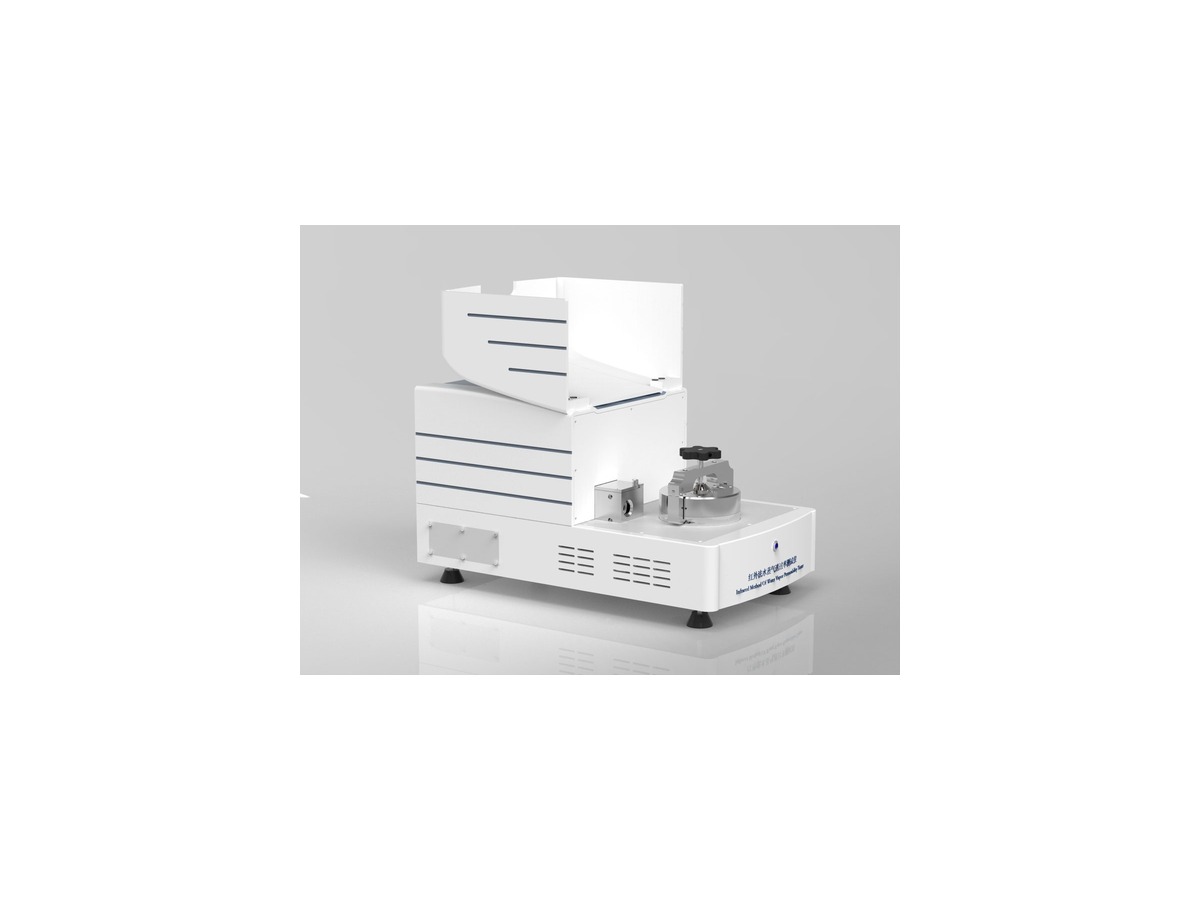
ASTM F1249, 'Standard Test Method for Water Vapor Transmission Rate Through Plastic Film and Sheeting Using a Modulated Infrared Sensor,' is the reference method for measuring how much water vapor passes through plastic films and sheets up to 3 mm thick. The specimen divides a test cell into a humidified wet chamber and a dry chamber purged with dry nitrogen; water vapor diffusing through the film is carried by the sweep gas to a modulated infrared sensor that quantifies moisture concentration at steady state. Results are reported in grams per square meter per day (g/m²·day), where a lower value indicates a better moisture barrier. The method is widely used for food, pharmaceutical and electronics packaging where moisture protection is critical to product stability.
1. Scope
ASTM F1249 applies to single-layer and multilayer plastic films, sheets and laminates up to 3 mm thick, spanning materials from low to moderate barrier levels. It measures water vapor transmission rate only; it does not evaluate total migration, mechanical strength or shelf life, so it is normally combined with seal, peel and tensile tests to build a complete packaging-integrity dataset. Typical applications include pharmaceutical blister foils, food laminates and protective films for moisture-sensitive electronics, where even a small moisture gain can degrade performance.
2. Principle
The specimen is clamped in a diffusion cell, separating an upper humidified chamber (commonly 90% RH) from a lower chamber swept with dry nitrogen. The humidity gradient drives water vapor to diffuse through the material; the permeated vapor is carried by the sweep gas to a modulated infrared sensor, which detects moisture at its characteristic absorption near 1.94 µm. By knowing the effective test area, carrier-gas flow and environmental parameters, the instrument computes a standardized WVTR once permeation reaches equilibrium. The modulated design rejects background drift, giving stable low-level readings without manual intervention.
3. Test conditions and specimen
The standard reference condition is 37.8°C ± 0.5°C with 90% RH ± 2% on the wet side; the dry side is purged with purified nitrogen (dew point ≤ −60°C). The effective test area is normally 50 cm², cut from a flat 100 × 100 mm sample free of pinholes, folds or contaminants. Before mounting, samples are conditioned at 23°C and 50% RH for at least 24 h, and 3–5 thickness points are recorded for permeance-coefficient calculation. A mandatory leak/blank test confirms there is no bypass around the specimen.
4. Steady state and calculation
ASTM F1249 defines steady state as three consecutive 30-minute reading groups whose deviation is ≤ 2%. After equilibrium is confirmed, the instrument reports mean WVTR, standard deviation and the permeation curve. The report must state test temperature, relative humidity, test area and specimen thickness; for homogeneous films the permeance coefficient (WVTR divided by thickness) lets laboratories compare materials of different gauges rather than judging by absolute WVTR alone. Retaining raw curves and calibration records supports traceability and referee testing.
5. Comparison with other methods
Compared with the gravimetric cup method ASTM E96, the infrared method is faster, more sensitive to low-transmission materials, and acquires continuous real-time data with minimal operator involvement. ISO 15106-3 (electrolytic) is another sensor method, whereas ASTM F1249 specifies the modulated-infrared route. The three approaches are not directly interchangeable, so every report must state the method and conditions used.
| Method | Standard | Detection | Best for |
|---|---|---|---|
| Infrared | ASTM F1249, ISO 15106-2 | Modulated IR | Mid–high barrier, fast |
| Electrolytic | ISO 15106-3 | Coulometric | High barrier |
| Gravimetric | ASTM E96 | Cup weight | General, slow |
6. LabStone solution
The LabStone W-IR series water vapor transmission rate testers operate to ASTM F1249 and ISO 15106-2, using a modulated infrared sensor to detect permeation automatically. Multi-cell configurations run several specimens in parallel under reference conditions such as 37.8°C / 90% RH, so a single laboratory can handle WVTR quality control and film-development validation for food, pharmaceutical and electronics packaging with consistent, reproducible data.