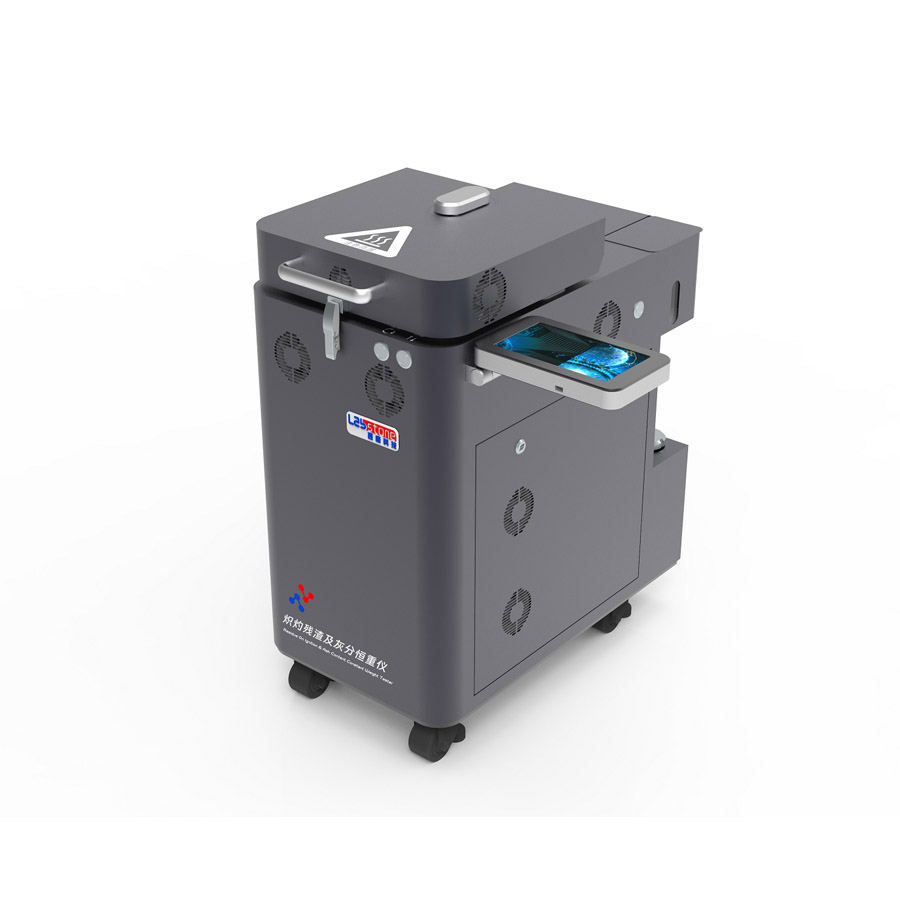
Ash determination is a fundamental means of assessing the inorganic content of a material, and it is used across food, chemical, pharmaceutical and environmental testing. Yet analysts frequently find that even when the standard procedure is followed exactly, results still vary between batches — and between operators. The cause is usually a small, easily overlooked error. This note examines the common error sources in ash determination and how modern instrumentation brings them under control.
Where the errors come from
Incomplete sample preparation. Incomplete charring is the primary error source. If the sample goes straight into a high-temperature furnace, the organic fraction may burn violently, spatter or even overflow the crucible, giving a low result; alternatively a dense carbon layer may form on the surface and block internal oxidation, giving a high one.
Moisture uptake during cooling and weighing. Ash consists largely of metal oxides and salts, and it is hygroscopic. In the traditional workflow the crucible must cool to room temperature in a desiccator and then be carried to the balance. If the laboratory is humid or the transfer takes too long, the sample absorbs atmospheric moisture and the weighed mass reads high.
Interference from residual heat. Even when the crucible looks cool, heat may remain inside. Thermal convection causes the balance reading to drift, and even slight thermal radiation disturbs high-precision sensors, leaving the reading unstable.
Control: from operator-dependent to system-dependent
Traditional control relies on operator experience — managing the charring rate, weighing quickly — but human factors cannot be eliminated entirely. An integrated automatic constant-weight system addresses the same problems through hardware integration and control algorithms:
Ramped heating and programmed temperature control. To counter uneven charring, multi-stage temperature ramps are supported (0–50 °C/min, adjustable). A low-temperature charring stage lets the sample decompose slowly and char completely before the high-temperature ashing stage begins, avoiding both spatter and encapsulation.
Controlled-atmosphere cooling. To eliminate moisture uptake, open-desiccator cooling is removed altogether. After ashing, the sample is transferred automatically to a sealed cooling chamber and brought to room temperature under water cooling and a protective atmosphere (dry air or nitrogen). The entire path is isolated from ambient air, which cuts the moisture-uptake route physically rather than procedurally.
Active balance protection and constant-weight judgement. A 0.1 mg analytical balance is built in, with thermal-radiation shielding and an isolating air curtain. Software performs consecutive weighings automatically and declares constant weight only when the difference between two weighings falls below the set threshold — 0.3 mg, for example — removing the subjective element of reading a drifting display.
Conclusion
Ash determination is a test in which accuracy is decided by detail. Moving error control from "depends on the operator" to "depends on the system" places the whole path — from heating to precision weighing — under one consistent regime.