
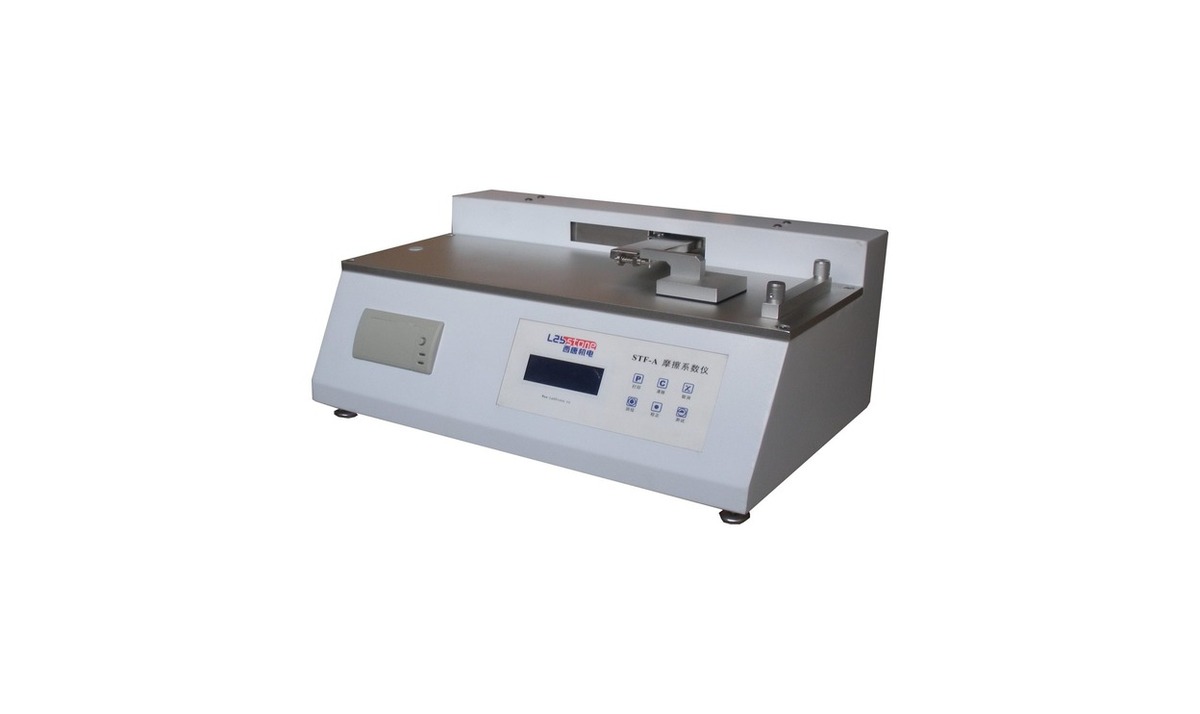
Coefficient of Friction Tester
Measures static and kinetic coefficients of friction of plastic films, paper and rubber — the number that decides whether packaging runs smoothly on a high-speed filling line.
Purpose | What it does for you
Measures static and kinetic coefficients of friction of plastic films and sheets, paper, rubber and paperboard. COF is the most overlooked yet most production-critical property of flexible packaging: too high and the film will not track, pull or register on a form-fill-seal machine; too low and stacks slip and pallets become unstable. Quantifying it lets you anticipate risk when changing material, supplier or slip-agent formulation.
Key Features
- Static and kinetic COF obtained in a single test run
- Stepless test speed 1–500 mm/min, settable per standard
- Automatic force zeroing and peak detection reduce manual reading errors
- Compact design for both workshop floor and laboratory use
- Graphical curves and multi-format reports for traceability
Operating Principle
One specimen is fixed to a horizontal sled bed and the other (or the same material) to the underside of a sled of specified mass. The bed (or sled) is driven at a set speed; a force sensor records the peak force at breakaway (static friction) and the average force during sliding (kinetic friction). Dividing each by the normal load gives μs and μk.
Technical Specifications
| Range | 0–5 N (model dependent) |
|---|---|
| Accuracy | ±0.5% FS |
| Test Speed | 1–500 mm/min (stepless) |
| Sled | standard sled, configurable per standard |
| Dimensions | 520 × 330 × 230 mm (L×B×H) |
| Power Supply | AC 110/220 V ±10%,50/60 Hz |
| Power | 200 W |
Note: Due to continuous product iteration and varying application conditions, the technical parameters on this page are typical reference values and are not to be used as acceptance criteria. For tender and customized projects, the product model, configuration and specifications are subject to the mutually confirmed technical agreement and the actual delivered product. For parameter matching tailored to your specific project, please contact us.
Standard Configuration
Main unit, standard sled, computer (some models), professional software, manual and factory calibration certificate. Final scope per the configuration list.
Application Scenarios
- Slip-agent formulation adjustment and acceptance for flexible films (GB/T 10006)
- Predicting runnability on high-speed packaging machines to cut downtime and scrap
- Surface friction evaluation of paper, paperboard and woven sacks
- Consistency check of sliding behaviour of pharmaceutical blisters and foil
Compliance Standards
Industries Served
- Packaging & Printing
- Food & Condiments
- Pharmaceutical & Biopharmaceutical
- Plastics & Rubber
- Textile & Leather
- Adhesive Products & Tapes
- Third-Party & Government Testing Institutes
Frequently Asked Questions
When is static COF more meaningful, and when kinetic?
Static COF reflects how hard it is to start moving, governing film pull and feed on bag-making machines. Kinetic COF reflects how smoothly motion is sustained, relating to high-speed stability and pallet/stack behaviour. In practice both are reviewed together, and most standards require reporting both.
Does LabStone support OEM/ODM and customised instruments?
Yes. Standard models ship as-is, while chamber count, specimen size, fixtures, temperature range and software modules (including the GMP Computerized System module) can be tailored to your SOP and URS. IQ/OQ/PQ validation documentation packages are available.
What is the typical lead time, and how is shipping handled?
Standard models usually ship in 4–8 weeks; customised builds depend on the agreed scope. Instruments are packed in export wooden cases and can move by sea, air or rail. We supply proforma invoice, packing list and certificate of origin (CO / Form E), and work under EXW, FOB, CIF or DAP terms.
How are installation, training and calibration handled after delivery?
We provide remote installation guidance, bilingual (Chinese/English) manuals and video training; on-site commissioning by our engineers is available. Users can self-calibrate with standard weights, reference films or calibrated leak standards, and third-party calibration certificates can be supplied.
What is the warranty, and how are spare parts supplied?
The instrument carries a 12-month warranty from acceptance plus lifetime maintenance support. Consumables (molecular sieve, desiccant, sealing grease, printer paper) are kept in long-term stock, and key components are international brands available worldwide. We respond to technical enquiries within 24 hours.
Do the instruments comply with ASTM, ISO and pharmacopoeia standards?
Yes. Every instrument lists its applicable standards on the specification page (ASTM, ISO, GB, YBB, Chinese Pharmacopoeia, USP, EP, JIS, DIN, TAPPI and more). The software outputs raw records and reports suitable for audit trails, with an optional GMP / FDA 21 CFR Part 11 compliance module.
Which languages does the software support, and can it integrate with a LIMS?
The software ships with Chinese and English interfaces; other languages can be added on request. Data export is available over RS232, USB, Ethernet or Wi-Fi, and reports can be exported to Excel, PDF or structured files for LIMS integration.