In packaging testing and polymer R&D, many people are puzzled when a gas-permeation report shows four entirely different values for the same film at once — gas transmission rate, permeability, diffusion coefficient and solubility coefficient. All four seem related to "gas passing through the material", but each points to a different stage of permeation, with entirely different physical meaning, calculation logic and use cases.
Gas does not pass through a polymer film "in one breath"; it is a three-step series process. First the gas molecules contact the surface and dissolve into the material; then the dissolved molecules diffuse from one side to the other under a concentration gradient; finally the molecules reaching the far surface desorb into the outside space. Each step corresponds to an independent quantitative indicator.
What the four parameters mean
Gas transmission rate (GTR) — also called gas flux — describes how much target gas passes through a sample of given area per unit time. It is the most practical, application-oriented indicator and the most common QC parameter in industry.
Permeability coefficient is an intrinsic property of the material. It fully strips out external variables such as sample thickness and test area, reflecting only the material's inherent permeation capacity for a given gas — equivalent to comparing materials of different thickness on the same baseline.
Diffusion coefficient describes how fast gas molecules move through the gaps between polymer chain segments once inside, and is strongly tied to chain packing, crystallinity and free volume.
Solubility coefficient measures how many gas molecules the surface can "capture" and dissolve internally, reflecting the affinity between material and gas.
Units and calculation
GTR is commonly expressed in cm³/(m²·24h·0.1MPa); the permeability coefficient in cm³·cm/(m²·24h·0.1MPa), with the Barrer often used in research (1 Barrer = 10⁻¹⁰ cm³·cm/(cm²·s·cmHg)); the diffusion coefficient in cm²/s; and the solubility coefficient in cm³/(cm³·atm).
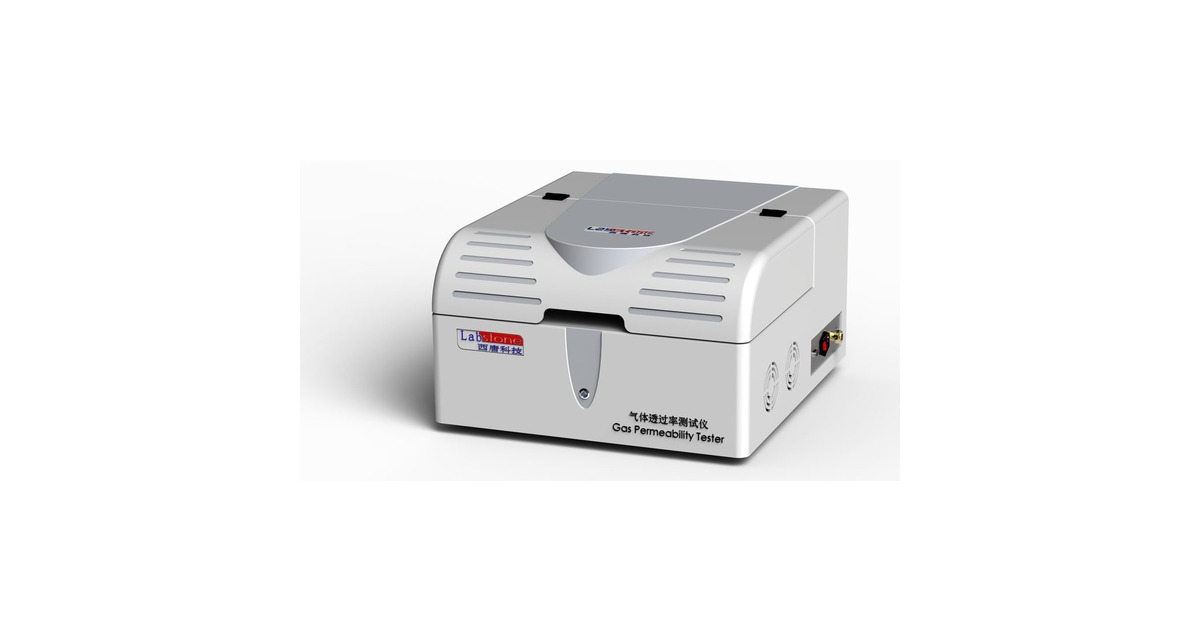
For calculation, GTR is obtained by a differential-pressure instrument monitoring the low-pressure-side change in real time, combined with chamber volume, temperature and sample area; permeability equals GTR times thickness divided by the pressure difference; diffusion is derived from the non-steady-state pressure–time curve on the low-pressure side by the time-lag method; and solubility equals permeability divided by diffusion.
Why research and industry care about different indicators
Of the four, only GTR is directly affected by sample thickness: doubling the thickness of the same material roughly halves the GTR. Permeability, diffusion and solubility are intrinsic and essentially unaffected by thickness when the formulation and process are unchanged.
Research papers favour the permeability coefficient because it removes the thickness variable and lets different groups compare intrinsic barrier performance on one baseline; manufacturers care more about GTR, which corresponds directly to the actual gas flux and shelf life of a fixed-thickness film and can be plugged straight into shelf-life formulas.
Example: why PE, PET, EVOH, PA and PVDC differ so much
PE is a non-polar polyolefin with flexible but loosely packed chains and low crystallinity: high diffusion, low solubility and a moderate overall permeability, making it a conventional low-barrier material. PET is a semi-crystalline polar polyester with more ordered chains; its diffusion is an order of magnitude lower than PE, placing it in the mid-barrier class.
EVOH is a highly crystalline polar material whose many hydroxyl groups form a dense hydrogen-bond network; its diffusion is two orders of magnitude below PET, but its solubility for water vapour is high, so it blocks oxygen excellently when dry and loses barrier rapidly at high humidity. PA (nylon) is strongly polar with a much higher water-vapour solubility than EVOH, so its oxygen barrier drops markedly after absorbing water. PVDC has a highly symmetric, highly crystalline chain structure; its diffusion is even lower than EVOH and its solubility for both oxygen and water vapour is weak, making it one of the rare ultra-high-barrier materials whose oxygen barrier is almost humidity-independent.
Conclusion
Seeing the division of labour among the four parameters prevents mixing up indicators of different dimensions. A differential-pressure instrument can output GTR, permeability, diffusion and solubility in one complete test — serving both industrial QC and the mechanistic needs of research.