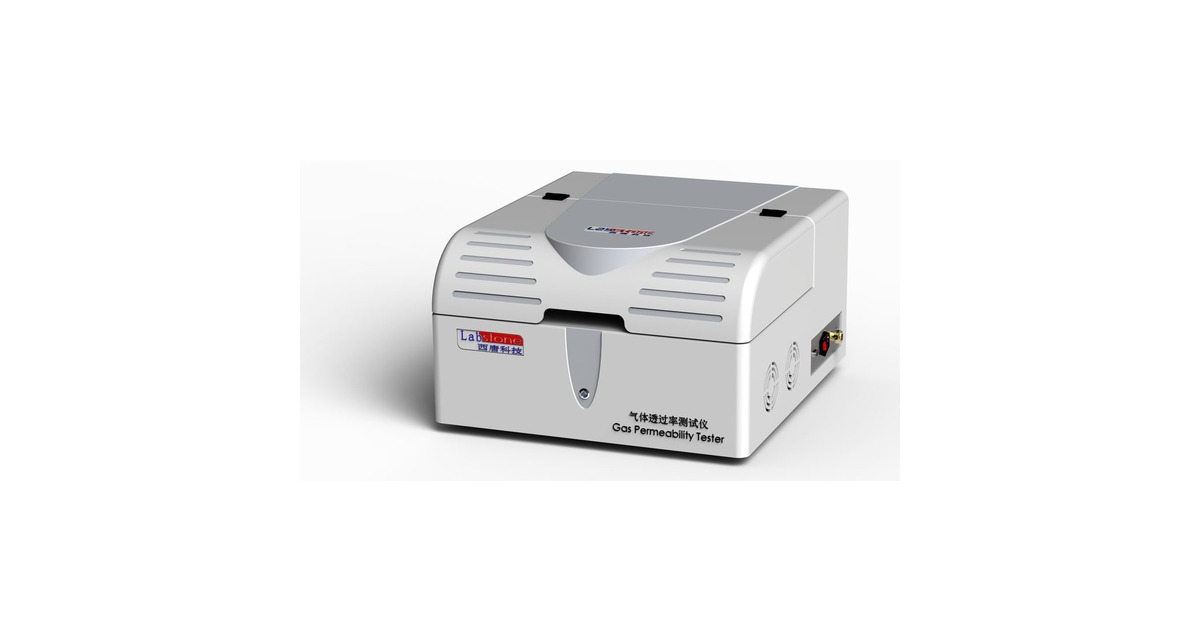
Gas Transmission Rate (GTR) is: under specified temperature and pressure differential, the volume of gas passing through one square metre of specimen per day (normalised to a 0.1 MPa differential), commonly expressed in cm³/(m²·24h·0.1MPa). The lower the value, the stronger the material's gas-barrier capability.
Analogy: inflate a balloon and in a few days it slowly deflates — gas molecules are "squeezing through" the film wall. GTR measures exactly how fast they get out; the denser the material, the slower the deflation.
Definitions in the standards
ASTM D1434 (Standard Test Method for Determining Gas Permeability Characteristics of Plastic Film and Sheeting), clause 3.1.1, defines the gas transmission rate (GTR) as "the quantity of a given gas passing through a unit of the parallel surfaces of a plastic film in unit time under the conditions of test" — SI unit mol/(m²·s), with mL(STP)/(m²·d) at one atmosphere pressure difference as the commonly used unit. The corresponding international method standard is ISO 2556 (manometric method).
Units and pressure conditions
Note that the differential-pressure GTR unit carries a pressure term (0.1 MPa), unlike the coulometric OTR unit of cm³/(m²·24h) — the two are based on different mechanisms and their results cannot be compared or converted directly. GTR values also vary with the test gas and temperature, so test conditions must always be stated in reports.
Test method: the differential-pressure method
The specimen divides the cell into a high-pressure chamber and a low-pressure chamber: the low-pressure side is evacuated first, then the test gas is introduced on the high-pressure side. Gas permeating the specimen raises the low-side pressure, and the pressure-versus-time curve yields the transmission rate. Relevant standards: 1038.1-2022 (China), ASTM D1434 (USA), ISO 2556 (international). The key advantage: by swapping the gas cylinder, one instrument tests oxygen, carbon dioxide, nitrogen, hydrogen, helium, air and more.
Difference and pairing with OTR
Differential-pressure GTR is a "universal gas" measurement, while coulometric OTR is oxygen-specific with higher sensitivity. Follow whichever method the product standard specifies: differential-pressure testing is common for general permeability evaluation and R&D screening; coulometric testing handles trace oxygen transmission in high-barrier materials. The two complement each other across accuracy and gas types.
References
- ASTM D1434, Standard Test Method for Determining Gas Permeability Characteristics of Plastic Film and Sheeting (ASTM International);
- ISO 2556, Plastics — Determination of the gas transmission rate of films and thin sheets under atmospheric pressure (International Organization for Standardization).
- These are the primary authoritative sources for the definitions and test methods in this article.